Care Doctor
A Temperature Is a Number With a Method Attached, So Write Both Down
Start with the thermometer in the drawer
Imagine a hypothetical cold evening. Someone in the house feels warm, the thermometer is somewhere in the bathroom drawer, and you want a trustworthy number before bed without turning a sniffle into a project. A few choices decide whether the number means much: which thermometer you use, how you place it, and what the person did just before.
MedlinePlus favors electronic thermometers; glass mercury models can break and release poisonous mercury.
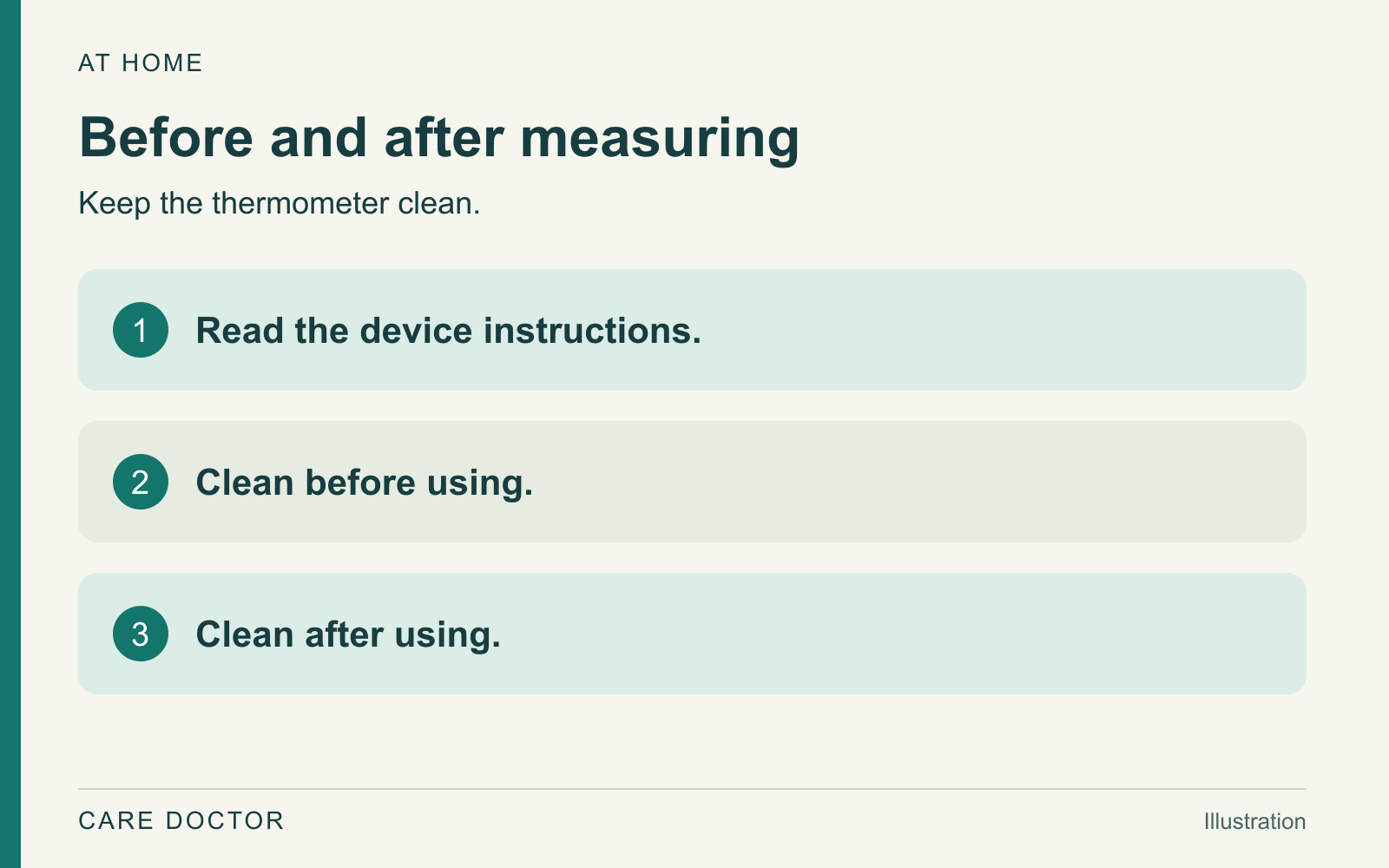
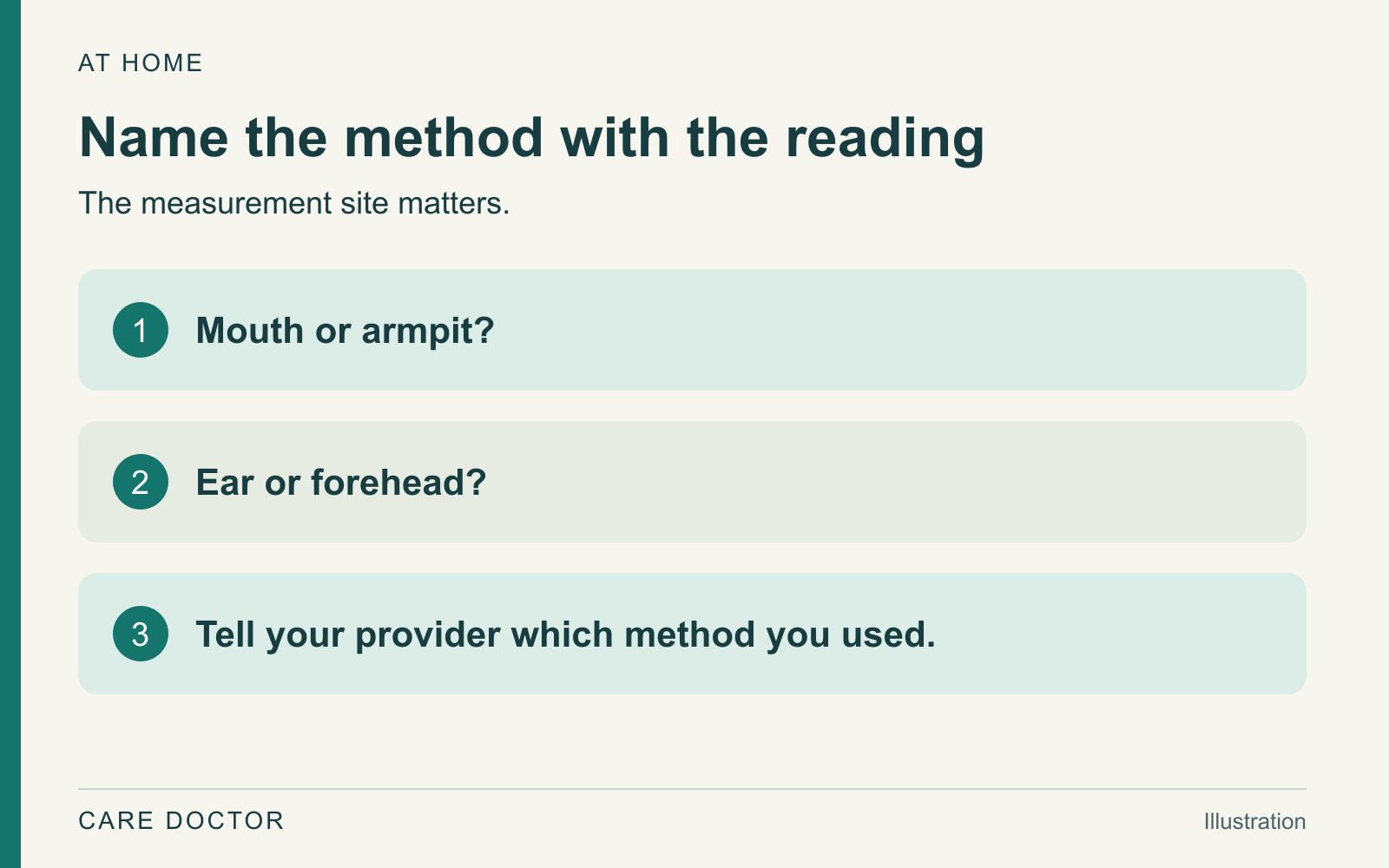
Mouth and armpit, step by step
These steps are for adults. Ask a provider about children; infants and small children cannot safely hold a mouth thermometer. For the mouth, put the probe under the tongue, close the lips and wait 3 minutes or the beep. For the armpit, keep the arm against the body and wait 5 minutes or the beep.
Clean probes before and after readings with rubbing alcohol or cool water and soap. After a hot bath or hard exercise, leave at least an hour; after smoking, eating, or hot or cold drinks, allow 20 to 30 minutes.
The waiting times are hard to honor when someone feels unwell. If you measure early anyway, say so in your notes.
Ear, strip and forehead models
MedlinePlus calls skin-temperature strips least accurate and not recommended for general home use; some users report less accurate ear readings than probes.
With an ear thermometer, the manual is the instruction to follow. FDA's guidance covers non-contact forehead models, not ear thermometers or probes. Placement and operation belong to the instructions that came with that device, and the manufacturer's website is a reasonable place to look if the paper copy is gone.
What FDA says about non-contact forehead thermometers
FDA's page on non-contact infrared thermometers, shortened to NCITs, describes them as a way to measure surface temperature. The listed benefits are practical: no skin contact, which may lower the risk of spreading disease between people, along with easy cleaning, a quick reading and a quick retake. The limitations matter as much. Head covers, the room and the position on the forehead may all change the number, and the close distance required puts the person holding it near the person being checked.
FDA says to follow the manufacturer's directions for the specific model strictly, and warns that improper use may lead to inaccurate measurements. A forehead reading is a surface reading that can depend on how the device was used, which is why the instructions deserve a read before the night you need them, not during it.
Set up the room, the device and the forehead
Start with the room. FDA says the use environment may affect performance, and typical instructions call for a draft-free space, out of direct sun and away from radiant heat sources. Operating limits vary by model, so check your own manual, but FDA gives 60.8 to 104°F (16 to 40°C) with relative humidity below 85 percent as the typical range. Typical instructions also recommend letting the thermometer sit in that room for 10 to 30 minutes before use, so it can adjust to the environment.
Next, the forehead. Typical instructions ask that the test area be clean, dry and not blocked during measurement. They also ask that excessive clothing, head covers such as headbands and bandanas, or facial cleansing products such as cosmetic wipes have not warmed or cooled it.
Then aim. Typical instructions say to hold the sensing area perpendicular to the forehead and have the person stay still during the measurement. The right distance between device and forehead is specific to each model, so the manual sets it. Do not touch the sensing area, and keep the sensor clean and dry. FDA's examples of incorrect use include holding the device at an angle to the forehead and measuring a forehead exposed to direct sunlight outdoors.
Cleaning differs for non-contact models. Between uses, follow the cleaning and disinfecting section of the product instructions, and let it settle any difference from general cleaning advice. Most NCITs should never be immersed in water or other liquids, so keep them out of the sink.
What the number generally means
MedlinePlus's body temperature norms page describes variation across people, age, activity and the time of day; adults tend to reach their daily low early in the morning. Studies described there put normal readings between 97°F and 99°F (36.1–37.2°C). Its average is 98.6°F (37°C). That entry says a reading above 100.4°F (38°C) usually points to a fever from illness or infection. MedlinePlus's temperature measurement entry also defines fever as more than 1 to 1.5°F above your usual temperature, while the norms entry specifies no method for its 100.4°F figure. Contact your provider if a reading is too high or too low, and tell them which method you used.
Two hypothetical readings show why one number says little. An adult who reads 97.8°F at 6 a.m. and 98.9°F at 5 p.m. by the same method has two readings inside that range, and part of the gap may simply be the clock.
Method adds a second layer. MedlinePlus notes that forehead and armpit readings are usually 0.5 to 1°F below oral, but exact relationships between methods are unclear. Describe readings from different methods as separate measurements when you speak with your provider.
What to record when a reading was rushed
The routine costs time. Between the waiting times, the cleaning and, for a forehead model, the room, the routine can take a good part of an evening that nobody has to spare. If a step was rushed or missed, record that with the reading and tell your provider. A note does not make an incorrectly taken reading accurate.
That note is short. After each reading, write down the number, the method, the type of thermometer, the time, and what the person had just been doing. For a forehead model, add the room and whether the person wore a headband or other head cover.
The routine also fails in some situations. A forehead model asks for a person who can stay still and a forehead that is clean, dry and uncovered, which is hard to arrange with someone restless or unwilling to take off a head covering. When the method on hand does not fit the person or the setting, the reading may be weaker, and that belongs in the note too.
Here is a hypothetical adult's note and the question it supports. The entry reads: 100.6°F, forehead model, 7 p.m., taken in a hallway the device had not been stored in. Before the visit, that becomes a clear sentence for a clinician: I measured with a forehead thermometer at 7 in the evening, in a different room from where it was kept, and the number was 100.6. How much weight do you give that reading, and would you like it repeated another way?
Before the appointment, what to carry in is simple: a temperature is a number with a method, a time and circumstances attached. Write the details down while the thermometer is still in your hand.