Care Doctor
Who Does the Work After Discharge, and Who Covers When They Need a Break?
Who holds the plan on discharge day
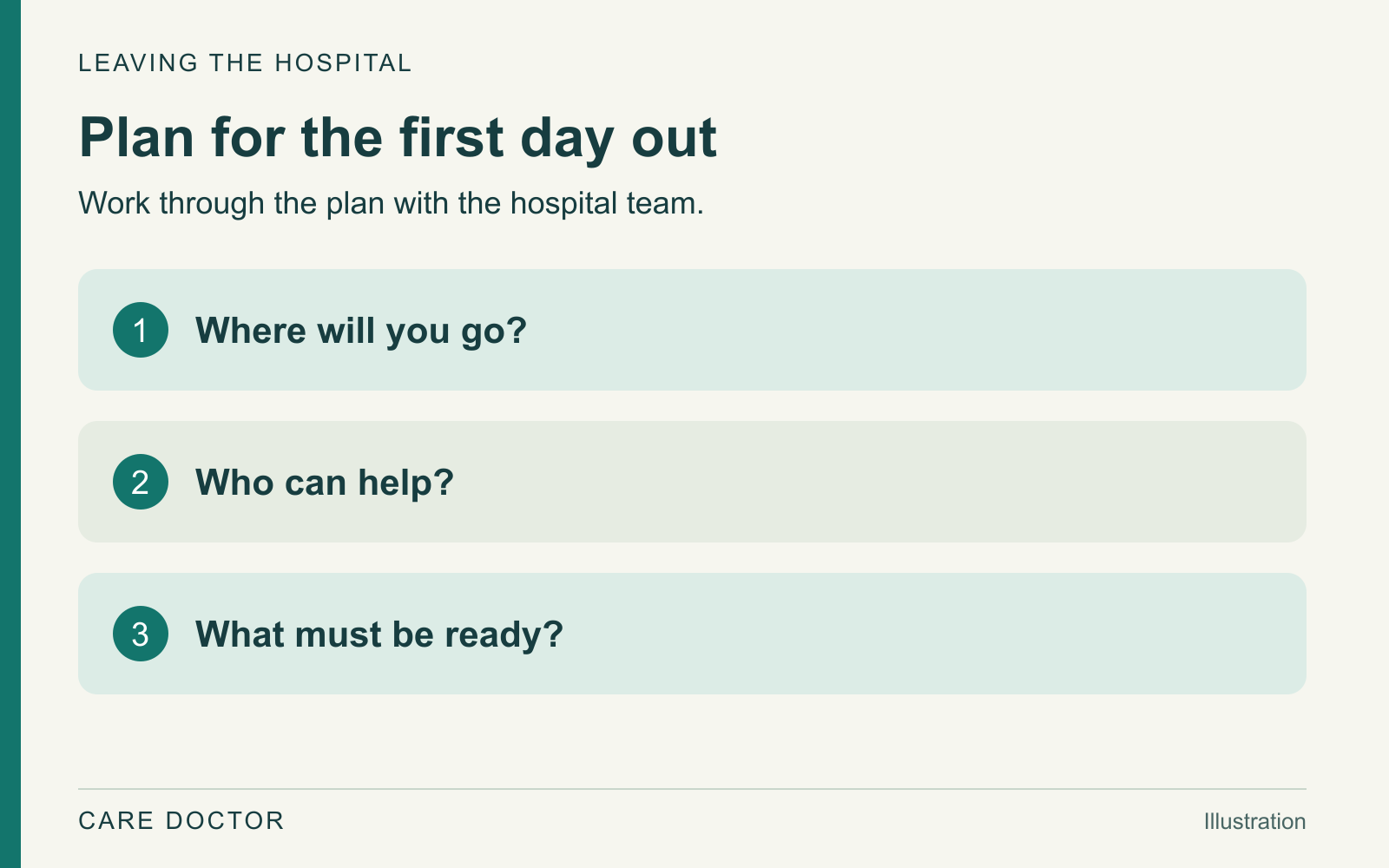
The person coordinating a hospital discharge, whether a relative, a friend or the patient, has three jobs before the patient leaves. Confirm where the patient is going next. Arrange who will do the daily work once they arrive. Collect a written plan that a second person could follow without phoning the first. When family or friends do it, the work is unpaid and easy to leave until the car is waiting at the curb. It goes better as a short sequence, done while hospital staff are still available to answer questions.
Where the patient goes and who helps
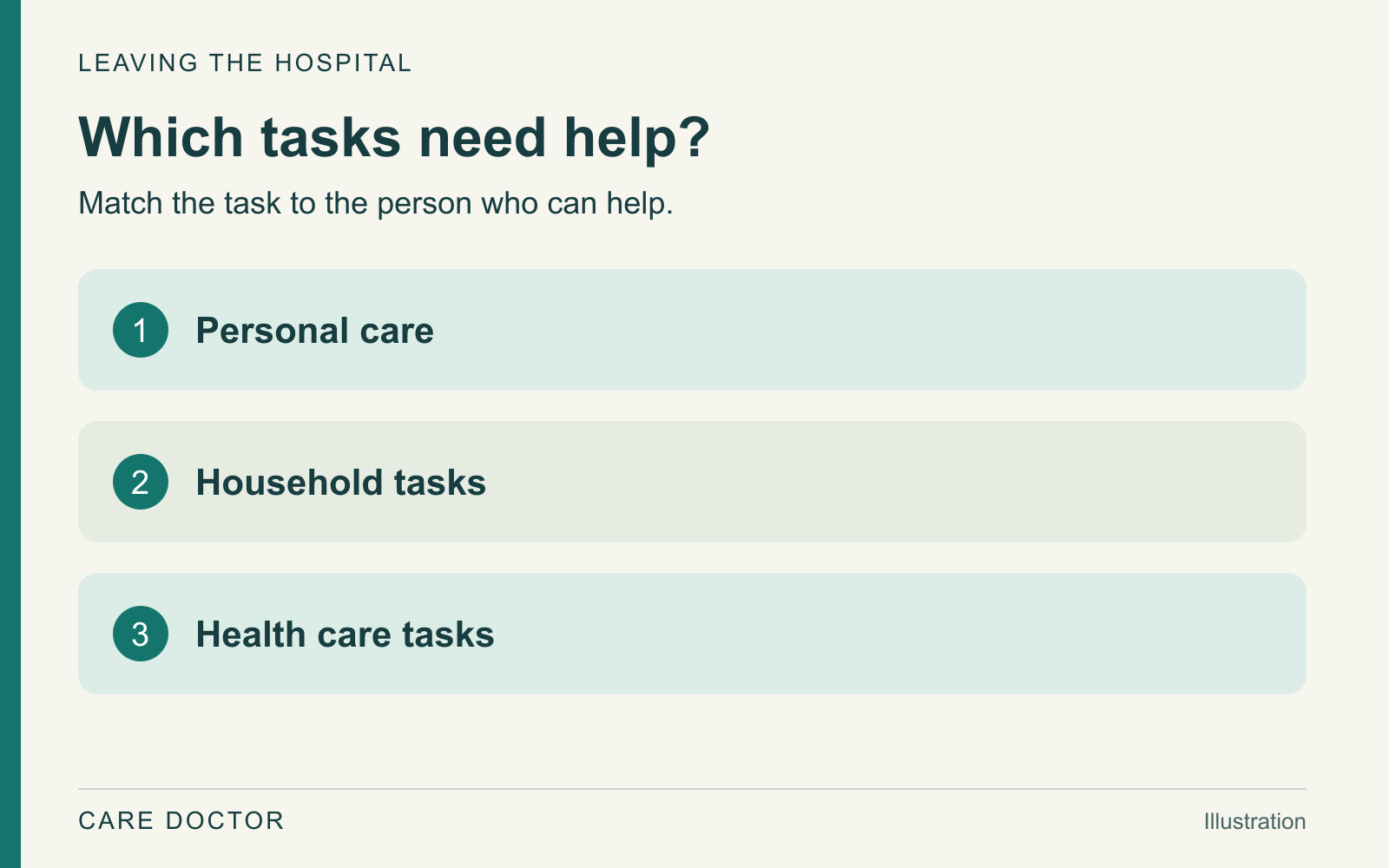
MedlinePlus describes a discharge plan as a list of what the patient will need or need to do after leaving, worked out by hospital providers with the patient and family or friends. A social worker, nurse, doctor or other provider helps decide between home and another facility, such as a nursing home or rehabilitation center. The hospital keeps a list of local facilities, and Medicare.gov has a nursing-home comparison tool. Help at home includes personal care (bathing, eating, dressing, toileting), household care (cooking, cleaning, laundry, shopping) and health care (rides to appointments, managing medicines, using medical equipment). Family or friends may be able to assist with some of it. For a home health aide, the discharge planner can suggest options. Ask the nurse or planner what equipment or supplies to have ready, such as a walker, shower chair or bandages.
The written plan, field by field
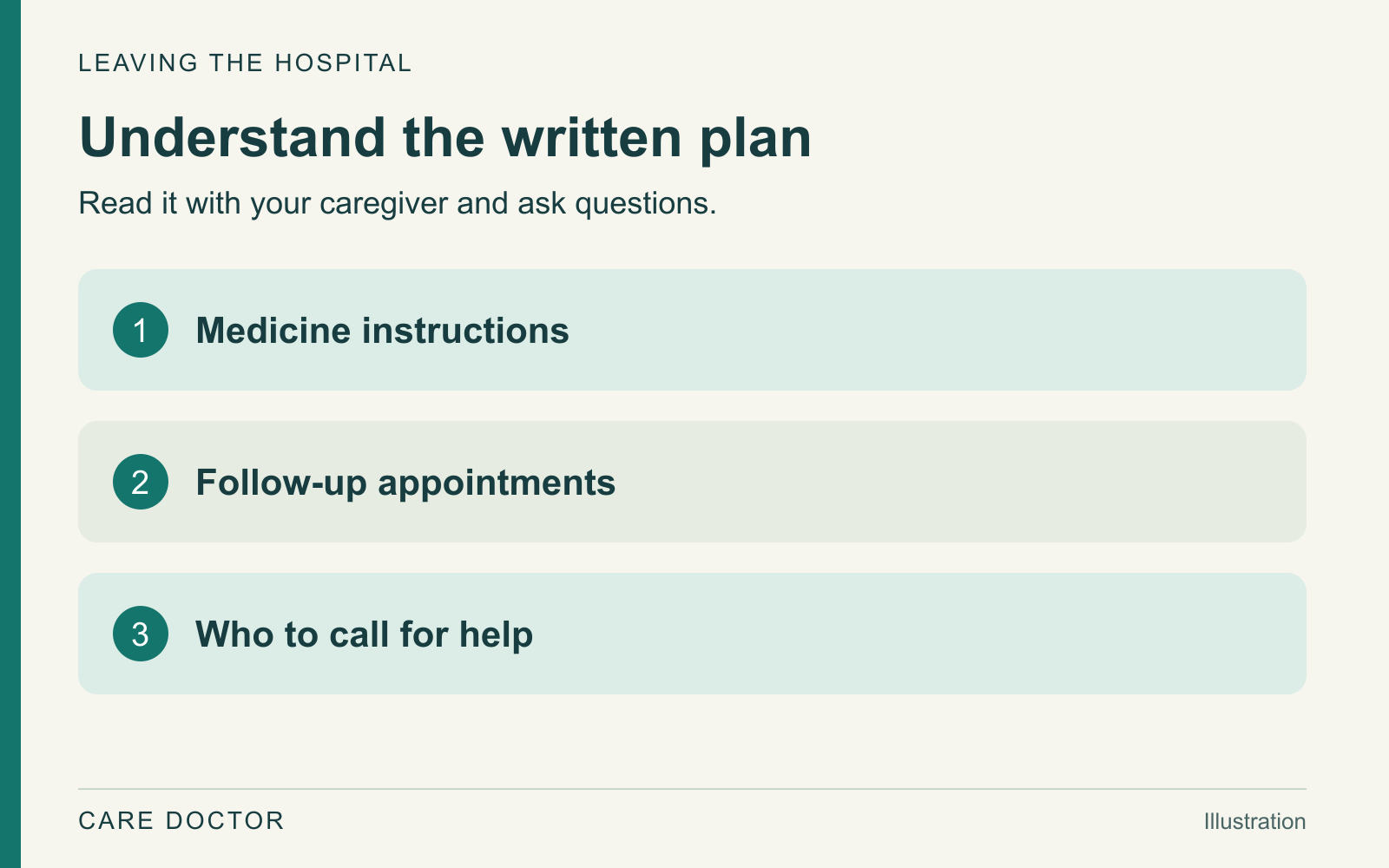
AHRQ's Taking Care of Myself: A Guide for When I Leave the Hospital is a fill-in form built for this job. It tracks the medicine schedule, upcoming appointments and important phone numbers. It also asks for the medical problem, medication allergies, the pharmacy, who to call with questions or problems and who to call for a serious health problem. The medicine schedule is split into morning, afternoon, evening and bedtime, and each row asks for the medicine's name, why it is taken, how much and how. Separate rows cover other medicines, such as one for a headache. The form has lines for exercise, what to eat and what to avoid. The clinical team supplies those answers. Nobody else should guess.
AHRQ's page says hospital staff complete the guide, except the patient's question sections, talk the patient through it, and hand over a copy to take home and bring to later appointments. For a coordinator, a blank line is therefore a question for staff, asked before discharge: who fills this in, and when? The page was last reviewed in November 2020, so ask whether the hospital uses its own version as well.
Check what is about the patient
Two parts of the AHRQ guidance are checks, not forms. Patients are asked to confirm that the information about them is correct, and the page names medication allergies, contact information and primary care provider details as examples. It also suggests getting familiar with AHRQ's guide before entering the hospital, which a planned stay allows and an emergency does not. In either case the check can happen at the bedside with the completed page in hand. A wrong phone number or a missing allergy is easy to fix there and harder to catch later.
Ask the team to check understanding
Ask the clinical team to check understanding by asking the patient to describe, in their own words, what they will do after leaving. AHRQ's page gives examples: when and how the patient will take their medicine, and when they will go to the doctor's office. AHRQ also advises studying the guide with clinicians so the patient or family members understand it and how to care for the patient at home. Inviting the second helper, in person or by phone, puts that advice into practice.
Describing the plan in your own words checks understanding. It does not hand the coordinator any clinical decisions, and the team, not the family, supplies answers on medicines, food and activity. If an answer is unclear, say so, ask again and write down what the team said.
A hypothetical handoff
Consider a hypothetical. A patient is due to leave on Friday, a sibling is coordinating from out of town and a neighbor has offered to help. On Wednesday the sibling asks the nurse who will complete the written plan and by when. On Thursday the sibling joins the patient by phone to go through it line by line, telling staff about any contact detail or allergy entry that is wrong. Before discharge, the sibling asks the team to have the patient describe the plan in their own words, and asks whether the neighbor can join by phone if the patient wants. Every blank becomes a written question, not something filled in from memory.
Then the work is divided on paper. One person is named for each recurring task: picking up medicines at the pharmacy listed on the form, keeping the medicine schedule where the patient can see it, confirming each appointment and going along, and carrying the completed plan to every visit. Each task gets a second name. A blank second name means the plan rests on one person, and Thursday is a better time to find that out than the second week.
Questions to bring to the discharge conversation
A coordinator might ask the nurse or discharge planner: Who completes the written plan, and can we see it before the patient leaves? Where does each medicine appear on the schedule, and what is it for? Which appointments are booked, and who do we call if one has to move? Who do we call with a question, and who for a serious problem? Will you ask the patient to describe the plan in their own words, and can a second helper join? If the people available cannot cover everything, what do you suggest? None of these asks the team to change a treatment. They ask for information to be written down.
When the checklist is not enough
A completed form records decisions. It does not make them, and it cannot supply a person. In a second hypothetical, every line is filled in, the patient lives alone and one relative can visit only on some days. The medicine schedule and appointment times are accurate, and still nothing says who is there on the other days. That gap needs a name and a conversation with the discharge planner while the patient is still in the hospital.
AHRQ's guide is adapted from Project RED (Re-Engineered Discharge), which AHRQ and the National Heart, Lung, and Blood Institute funded. AHRQ says the program showed that preparing patients to care for themselves after leaving the hospital can improve patient safety and reduce rehospitalization, and that a written discharge plan is one of its 11 elements. AHRQ gives no figures for the program's effect. A binder with colored tabs is still only a binder if nobody has read it.
If the coordinator needs a break
AHRQ tells patients to share the guide with family members and others who want to help, so they know how to help, and to bring it to every doctor appointment so the doctor knows what the patient has been doing since leaving the hospital. That is the backup plan in miniature. Make a copy, tell the second person where the original lives, and walk them through the medicine schedule, the appointment pages and the phone numbers while staff are still available to answer questions.
This step does not suit every household. If no second person exists, the next call goes back to the discharge planner.
So before the patient leaves, put the question where everyone can see it: who is doing this work, and what happens on the day they need a break?