Care Doctor
Drank Orange Juice During Your Fast? Say So at Check-In
The prep that is easy to skip
Say you have a lab appointment early next week, an instruction sheet from your provider's office, and a calendar with no spare hour for phone tag. This is a hypothetical, but the constraint is ordinary. The visit is the easy part. The preparation is where a small slip can happen, because what you eat, drink and take beforehand can change what a sample shows. You would like to get ready once, correctly, and not wonder afterward whether the result reflects your health or your breakfast.
MedlinePlus describes a lab test as a procedure in which a provider takes a sample of your blood, urine, other body fluid or body tissue to learn about your health. A provider may order one to help diagnose or screen for a condition, to monitor a disease or check whether a treatment is working, or to get general information about your organs and body systems, as with an annual checkup. Screening means looking for a disease before symptoms show up.
Three steps that apply to every test
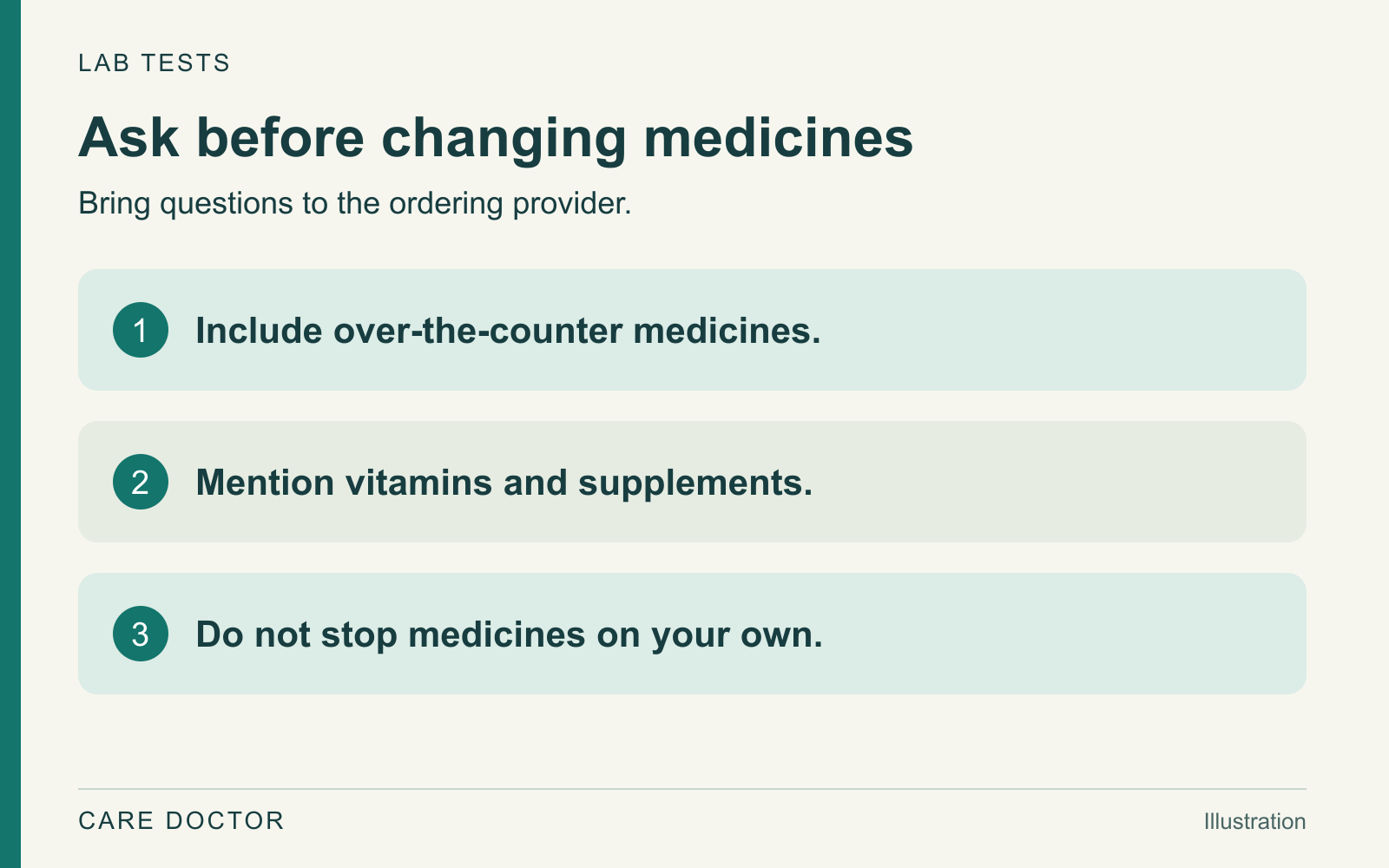
For any lab test, MedlinePlus gives the same short list. Follow every instruction your provider gives you. Tell your provider or the lab professional if you did not follow those instructions exactly. Tell your provider about any medicines, vitamins or supplements you take. Taking these steps can help make sure your results will be accurate and reliable.
Many tests need nothing more. For plenty of them, you only answer questions from your provider or the lab professional. Preparation, when it is required, is specific to the test, which is why guessing is a poor plan. If your instruction sheet is silent about fasting, ask before you invent a rule.
Confirm the instructions before the day
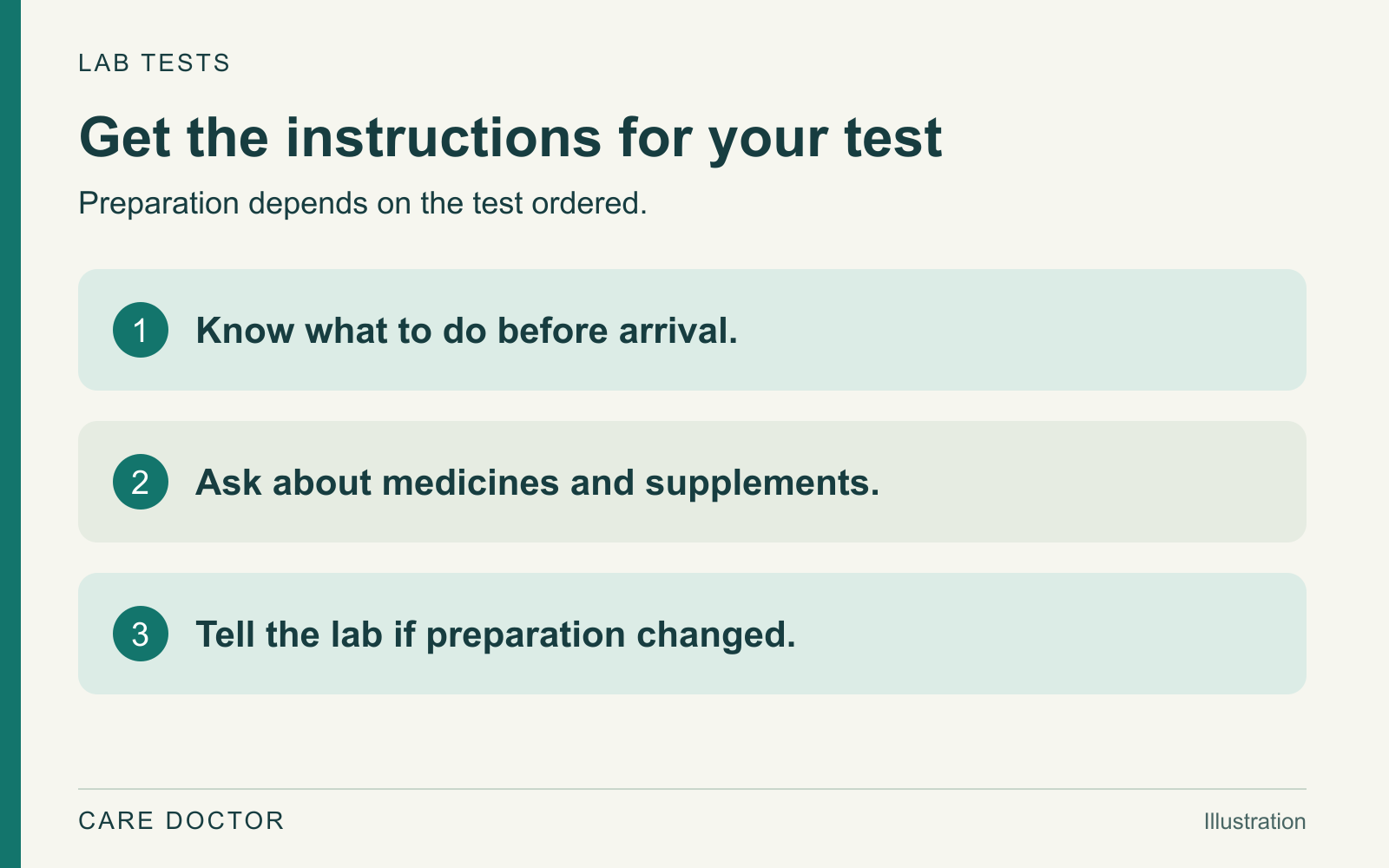
MedlinePlus advises you to understand your preparation instructions before the day of your test, and to talk to your provider if you have questions or concerns. Treat that as a deadline. A question asked two days ahead has time to be answered. The same question asked at the lab counter, on an empty stomach, mostly has time to be regretted. Read the instructions when you get them, find the lines that mention food, drink, medicines or timing, and mark whatever is unclear.
A good first question is this: does my test have any preparation, and if I need to fast, for how long? MedlinePlus says the length of a fast can vary, so the number of hours is the detail to get from your provider rather than assume. Beyond that, ask whatever else the instructions leave unclear. MedlinePlus says to talk to your provider if you have questions or concerns about preparation, and your provider can tell you whether there are special instructions to follow.
Tell the lab what actually happened
MedlinePlus puts it plainly: tell your provider or lab professional if you did not follow the instructions exactly, and be honest about it. Even a minor change can have a big effect on results. Its example is blood glucose, also called blood sugar. Some medicines raise or lower it, so taking them too close to a blood glucose test could change what the test shows.
Here is a hypothetical. You were told to fast overnight, and at six in the morning you drank a few sips of orange juice without thinking. It feels too small to mention. The guidance points the other way, because small departures are exactly what it warns about. Orange juice is not water, so it falls outside a fast as MedlinePlus defines it. Say so at check-in, in one sentence, and let the provider or lab professional decide what it means for the test. That decision is theirs.
Medicines, vitamins and supplements
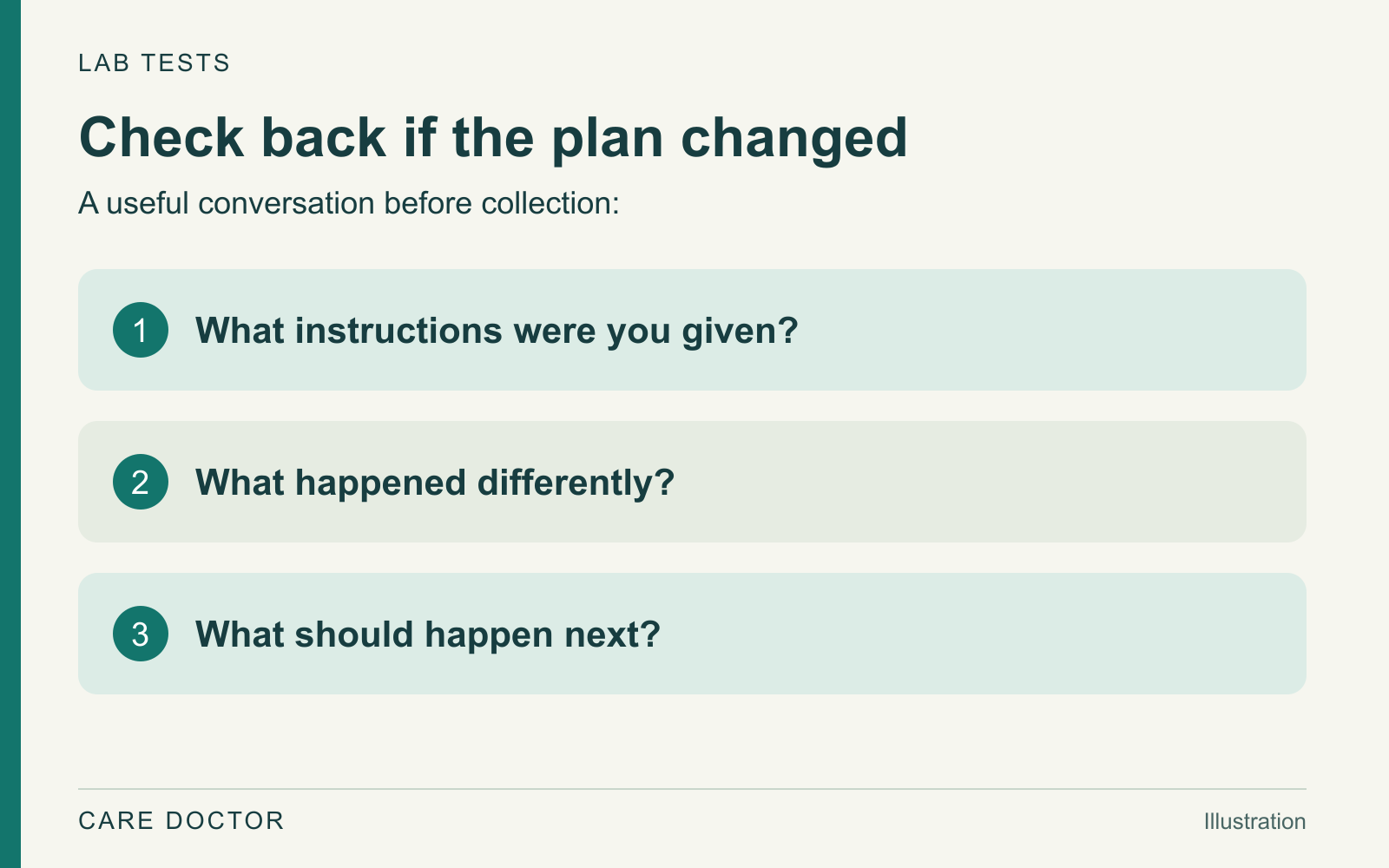
Your provider needs the whole list, and MedlinePlus names three categories: medicines, vitamins and supplements. Over-the-counter products count too. For some tests you may be asked to avoid certain medicines or supplements, so the list is what lets your provider decide whether that applies to you. Write it down before you call: the name of each product, how often you take it, and when you last took it.
Then ask one thing: should I take my usual medicines and supplements before this test, or should any of them wait? MedlinePlus attaches one firm rule to that conversation. Do not stop taking any medicine unless your provider tells you to. If a fast and a morning medicine seem to collide, that is a question for your provider, not something to settle alone.
What fasting means, and why it matters
Fasting, in MedlinePlus's definition, means you do not eat or drink anything except water for up to several hours or overnight before the test. The reasoning is about the bloodstream. Nutrients and ingredients in food are absorbed into your blood, and they may still be there when your sample is taken and may change the results of certain blood tests. Fasting can improve the accuracy of those results.
Water is the one exception, and for some tests it is more than allowed. MedlinePlus says you may be asked to drink extra water before certain blood tests, to help keep more fluid in your veins, and to drink water 15 to 20 minutes before certain urine tests. Anything else, including the morning coffee, falls outside that definition. Among the tests MedlinePlus lists as commonly requiring a fast are the blood glucose, cholesterol levels, triglycerides and calcitonin tests. If yours is not on that list, still check, because the list is a set of examples, not a rulebook.
Other preparations a provider may ask for
Beyond fasting, MedlinePlus lists several requests a provider may make. You may be asked to avoid specific foods and drinks, such as cooked meats, herbal tea or alcohol, to avoid overeating the day before, to not smoke, or to skip strenuous exercise or sexual activity. A creatinine test may call for fasting or for avoiding cooked meats. A cortisol test may call for resting before the sample is taken and for going without eating, drinking or brushing your teeth for a set time. A 5-HIAA test may involve avoiding foods that include avocados, bananas, pineapples, walnuts and eggplants. The details differ by test, so use the sheet you were given. Where it and a general list disagree, the sheet wins.
When the plan does not fit
The approach so far, which is to read the instructions, ask early and report honestly, can fall short in one ordinary way. The instructions may be silent on something you do. Suppose, hypothetically, that your sheet says nothing about a supplement you take, and the office is closed until after your appointment. MedlinePlus gives two anchors: tell your provider or lab professional about what you took, and do not stop any medicine unless your provider says to. So write down what you took and when, and say it at check-in.
A fair objection: a routine test hardly seems to deserve this much attention. For a test with no special preparation, the extra work may not be needed. Many tests need no special preparation beyond the basics, but those basics still apply: follow your provider's instructions, say so if you did not follow them exactly, and tell your provider about any medicines, vitamins or supplements you take. When special preparation is needed, the extra work is reading the sheet, writing the list and sending a message. The cost of skipping it is that a small slip may have shifted your results, and you may not know it did.
A day-of checklist
Put these in one place the night before: the written instructions, your ID and insurance card if the office or lab has asked for them, your medication, vitamin and supplement list, and water if you are fasting or have been asked to drink extra. Then check timing. Work backward from the appointment to know when the fast begins, note when you last took each medicine, and ask whether your test is one of the urine tests with a water step 15 to 20 minutes beforehand.
What to understand before you go
Three things matter before the appointment. Your test either has preparation or it does not, and the provider who ordered it can say which. What you actually did, including the juice, the dose taken too close to the test or the supplement missing from the sheet, is part of what MedlinePlus asks you to tell your provider or lab professional, so report it. And any decision about stopping a medicine belongs to your provider. If you send one message, ask what preparation your test needs and attach your medicine list.