Care Doctor
Turkey Still Frozen Days Before Dinner? Cold Water Is a Same-Day Job
Start from the weight on the package
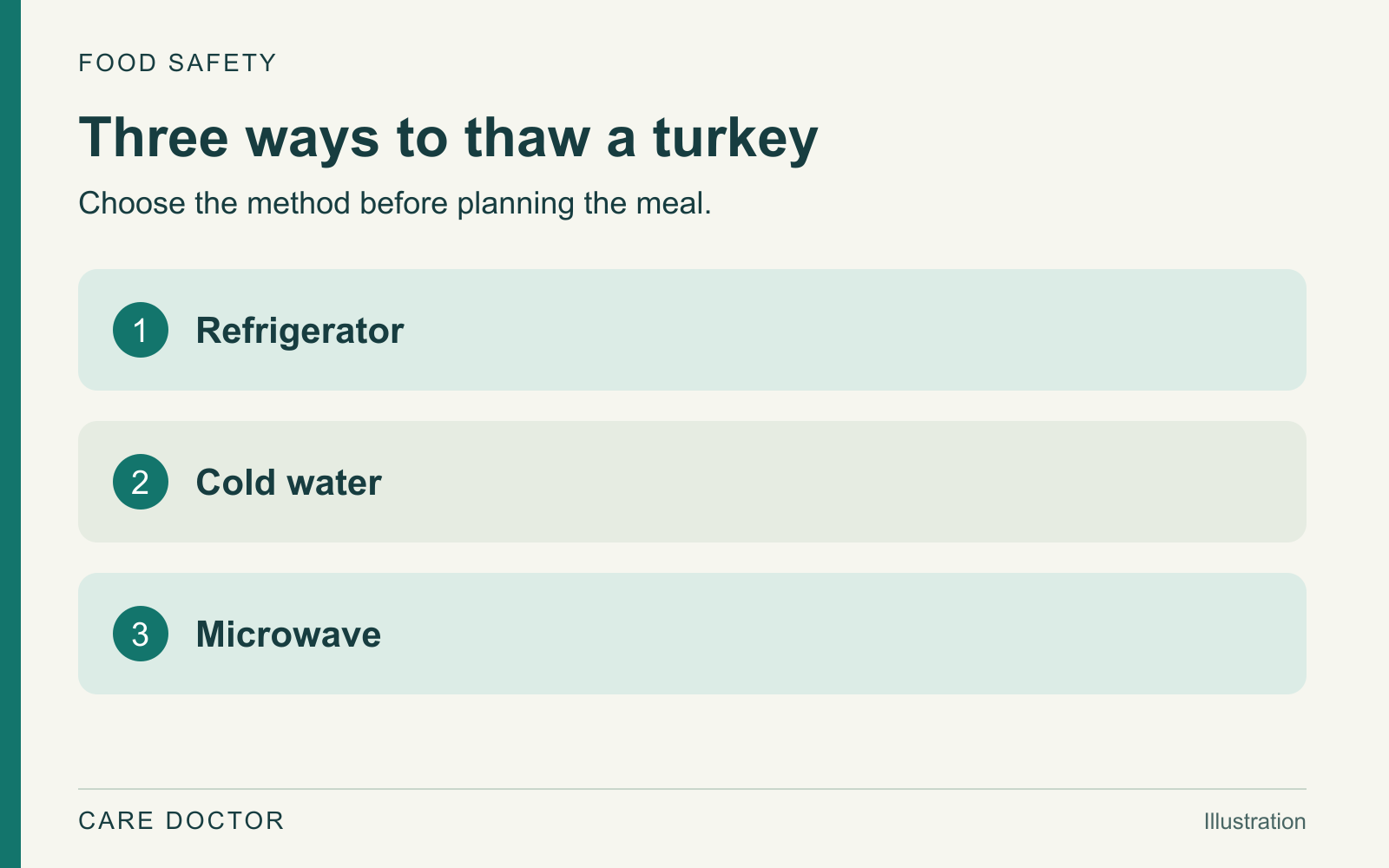
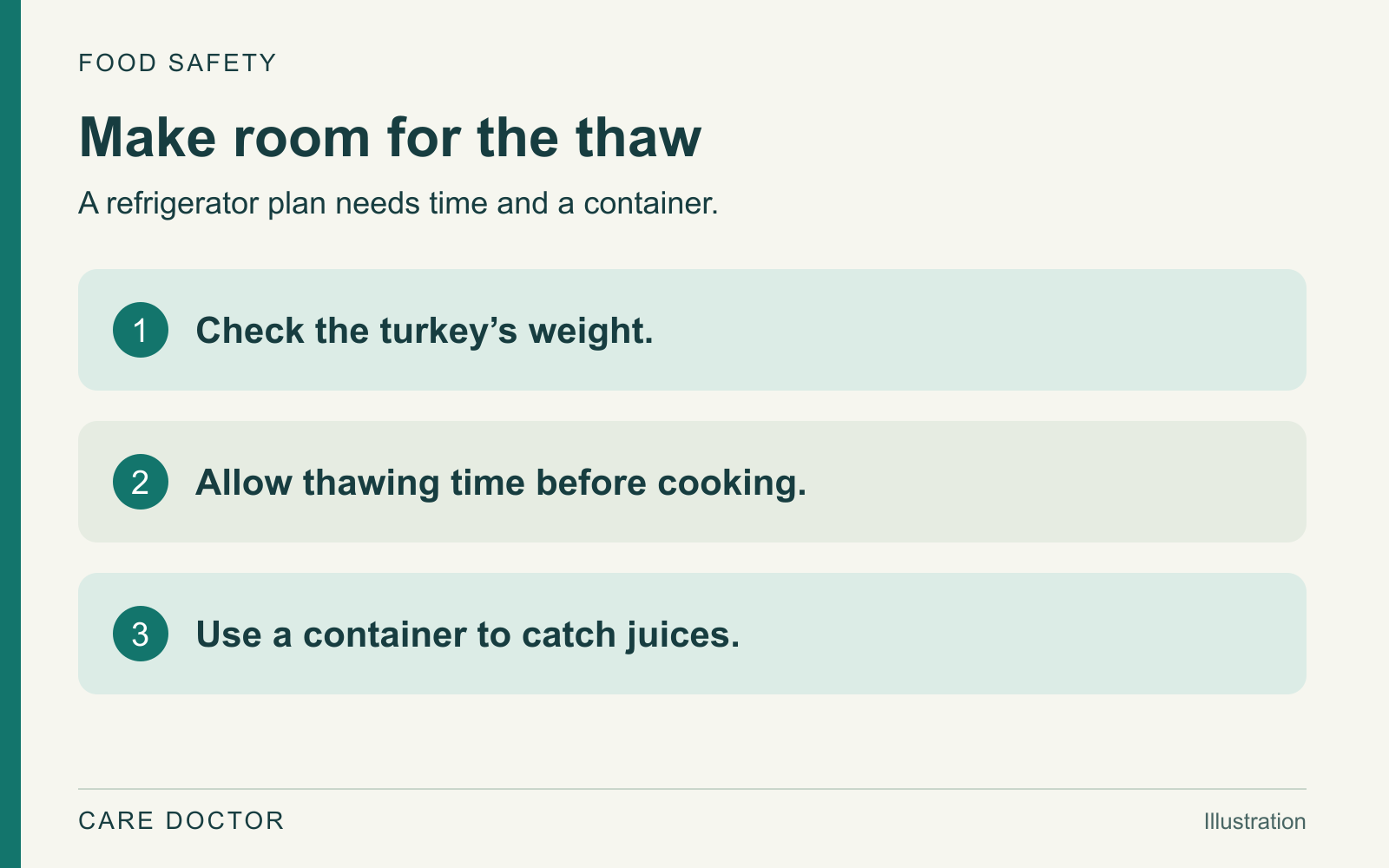
The CDC's holiday turkey page gives one rate to plan around: allow about 24 hours of refrigerator thawing for each 4 to 5 pounds of turkey. That is a federal food-safety guideline, and USDA's Food Safety and Inspection Service ties the same rate to a refrigerator set at 40°F or below. Divide the weight on the package by 5 for the short end of the range and by 4 for the long end, and the result is an approximate number of days. A 14-pound turkey, for example, works out to 2.8 to 3.5 days. The division is arithmetic on the agency rate, not a figure either agency publishes, and the rate itself is approximate.
USDA publishes a second figure for the same job: a table of whole-day ranges by weight band for whole turkeys. The two do not always match. For a 14-pound turkey, the division gives 2.8 to 3.5 days and the table's 12-to-16-pound band says 3 to 4. For 17 pounds, the division gives 3.4 to 4.25 days and the 16-to-20-pound band says 4 to 5. For 21 pounds, it gives 4.2 to 5.25 days and the 20-to-24-pound band says 5 to 6. In these three examples the table's long end runs a half to three-quarters of a day past the division's, and the gap at other weights will differ. Both figures are approximate, and neither forecasts how long a particular turkey takes in a particular refrigerator. For a whole turkey weighing 12 to 24 pounds, a cautious planning choice is the longer published allowance, checked against the 1 to 2 day limit on holding it after thawing. The table stops at 24 pounds, so a larger bird falls outside it.
Why a frozen middle is not reassuring
It can seem that a turkey with an icy center cannot be doing anything risky yet. USDA's thawing page names what that leaves out. Left on the counter for more than 2 hours, a package is not at a safe temperature: even with the center still frozen, the outer layer is in the Danger Zone, 40 to 140°F, where foodborne bacteria multiply rapidly. The CDC says never to thaw a turkey on the counter. That impression comes from the middle. The guidance is concerned with the outer layer.
Storage before thawing follows the same logic. USDA says a frozen turkey is safe indefinitely, but once it starts to thaw, any bacteria that may have been present before freezing can begin to grow again. The CDC asks for a freezer at 0°F or below and says not to keep a turkey where the temperature cannot be closely monitored: a car trunk, a basement, a back porch or snow.
Refrigerator thawing: count back from the oven
In the refrigerator, the CDC says to keep the turkey in its original wrapping and set it in a container, which stops the juice dripping onto other food. Once thawed, it can stay in the refrigerator 1 to 2 days before cooking. That holding window gives this method some slack, but only 1 to 2 days of it, and it is the limit to check against when choosing a start day.
Consider a hypothetical meal, using approximate thawing figures. Thanksgiving this year is Thursday, November 26, 2026. Suppose a household plans to put a 14-pound turkey in the oven that day. The division gives 2.8 to 3.5 days and USDA's table gives 3 to 4, so the longer allowance is 4 days. Counting back 4 days from Thursday, at the time of day the bird will go into the oven, gives Sunday, November 22. If the thaw ran at the short end of the division, about 2.8 days, the turkey would sit thawed for roughly 1.2 days before Thursday, inside the CDC's 1 to 2 days. A start a day earlier would change that. A 5-day wait with a 2.8-day thaw leaves about 2.2 days thawed, past the limit. So the start day depends on the cooking time, the longer allowance, and the actual thaw and holding conditions, not on division alone. Roasting time matters because dinner at a set hour means the oven goes on hours earlier, and the thaw must be finished by then.
Cold water and microwave: faster, with no slack
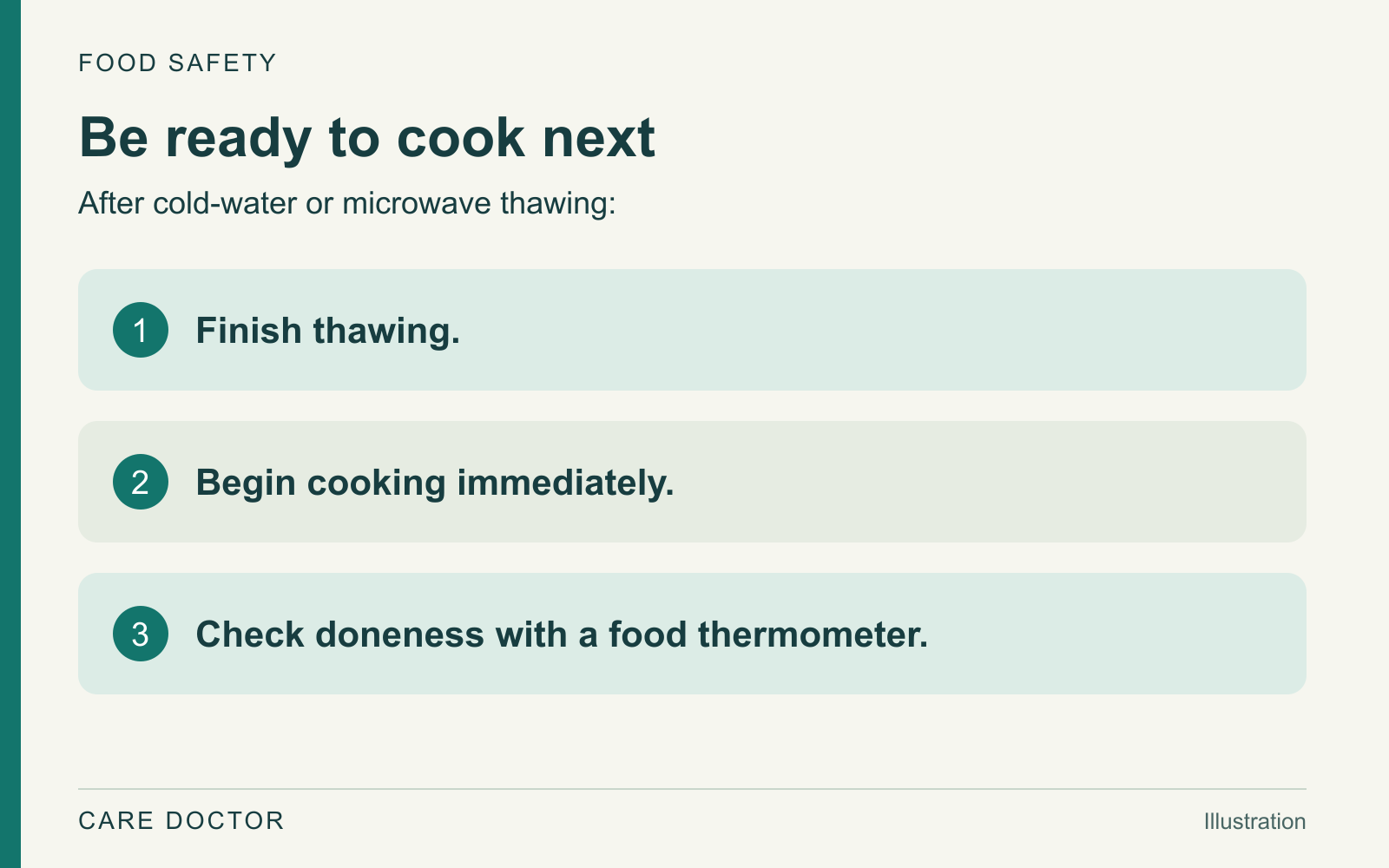
Cold-water thawing trades days for attention. The turkey goes into a leakproof plastic bag first, which the CDC says keeps juice from spreading in the kitchen and keeps the bird from absorbing water that could make the cooked turkey runny. Cover it completely with cold tap water, change the water every 30 minutes, and allow about 30 minutes per pound. USDA's table puts a 12-to-16-pound turkey at 6 to 8 hours, so a 16-pound bird means about 16 water changes at one every 30 minutes. A turkey thawed this way must be cooked immediately.
Microwave thawing defers to the appliance: follow the manufacturer's instructions, then cook immediately. USDA explains why. Some areas may warm and begin to cook during microwaving, and holding partially cooked food is not recommended because any bacteria present would not have been destroyed. Cold water and microwave share a constraint the refrigerator lacks: no holding window.
When the start day slips
The refrigerator method fails in a predictable way: the start day slips by. Suppose it is Tuesday morning, a 16-pound turkey is still solid from the freezer, and dinner is Thursday. Both refrigerator figures for that weight start at 3 days or more, and the calendar offers two, so both planning figures put the finish past Thursday. Cold water is one way to close the gap, with its own sequence. First, thawing: at about 30 minutes per pound, a 16-pound bird takes an estimated 8 hours, with the water changed every 30 minutes. Second, because the CDC and USDA say a turkey thawed this way must be cooked immediately, the thaw has to be timed to end when the oven is ready, which in practice puts it on cooking day. Third, roasting: USDA's chart gives roughly 3 3/4 to 4 1/4 hours at 325°F for an unstuffed 14-to-18-pound bird, an approximate range that shifts with the oven, the pan and other variables. Stuffing changes that time, and the stuffing has its own 165°F check at its center. Fourth, the thermometer check decides doneness, and the bird stands 20 minutes before carving. The cold-water estimate applies to a turkey that starts fully frozen. A bird that has already spent a day or two thawing in the refrigerator is partly thawed, and the 30-minutes-per-pound estimate is not its remaining time.
A turkey that reaches cooking day partly frozen is a separate case. USDA says a partially frozen turkey requires longer cooking, and its roasting times assume fresh or thawed birds at 40°F or below. So a thawed-bird cooking time chart cannot decide when a partly frozen turkey is done. The CDC's oven instructions call for a completely thawed turkey and point to separate USDA guidelines for roasting one that is not fully thawed. The check that controls is 165°F on a food thermometer, which a pop-up timer does not replace.
Handling raw turkey without spreading it
Cross-contamination means germs moving from raw turkey to food, hands or surfaces that were never meant to carry them. The CDC says raw turkey and its juice can contaminate anything they touch. Its steps: wash hands with soap and water for at least 20 seconds before and after handling turkey; use one cutting board for raw turkey and another for produce, bread and other foods that won't be cooked; never put cooked food or fresh produce on a surface that held raw turkey; and wash boards, utensils, dishes and countertops with hot soapy water afterward.
One habit has its own warning. Federal agencies have recommended against washing turkey or chicken since 2005, the CDC says, yet a 2020 survey cited by the CDC found 78% of participants reported washing or rinsing turkey before cooking. Old recipes and family cooking traditions may encourage it. Washing can spread poultry juice to other food, utensils and countertops, and the CDC cites a USDA study in which 1 in 7 people who cleaned their sink after washing chicken still had germs in it.
Cooking, stuffing and leftovers
For roasting, the CDC says to set the oven to at least 325°F and use a roasting pan 2 to 2 1/2 inches deep. USDA lists many things that change roasting time, among them an inaccurate oven, dark versus shiny pans, foil tents and oven cooking bags, so the safety test is a thermometer, not the clock. Check for 165°F in three places, avoiding bone: the thickest part of the breast; where body and thigh join, aiming toward the thigh; and where body and wing join, aiming toward the wing. Let the bird stand 20 minutes before carving.
Stuffing adds a second thing to measure. A stuffed turkey takes longer to cook than an unstuffed one, USDA publishes a separate chart for it, and the stuffing's center needs its own 165°F reading. The CDC calls a casserole dish the safest place to cook stuffing, because that makes it easier to know it is thoroughly cooked. If it goes inside the turkey, it should go in just before cooking. Germs can survive in stuffing that has not reached 165°F. Leftovers have a clock too: refrigerate at 40°F or colder within 2 hours of cooking, or within 1 hour if the food was exposed to temperatures above 90°F. Cut a large piece of turkey smaller so it cools quickly, eat it within 3 to 4 days, and reheat leftovers to at least 165°F.
A short plan, and where it stops
For a whole turkey weighing 12 to 24 pounds, the planning sequence is short. Read the weight, find both refrigerator figures, the division and USDA's table, and count back from the time the turkey goes into the oven by the longer one. Treat the result as an approximate planning start, not a promise of when the bird will finish. Thaw in the original wrapping, in a container, in a refrigerator at 40°F or below, and remember that a thawed turkey can wait there only 1 to 2 days before cooking, so a start much earlier than the longer allowance can exceed that limit. Actual readiness decides on the day, since a partly frozen bird takes longer to cook. If the start day has passed, treat cold water as a same-day job: leakproof bag, cold tap water covering the bird, water changed every 30 minutes, oven ready, cooked immediately after thawing. Then confirm 165°F in the three places: the thickest part of the breast, the thigh joint and the wing joint.
USDA's refrigerator thawing table covers whole turkeys from 4 to 24 pounds at 40°F or below, with approximate time allowances. For smoking, frying or roasting a bird that is not fully thawed, the CDC points to separate USDA guidelines. What a cook needs is a thawed bird, and what decides doneness is a thermometer reading of 165°F.