Care Doctor
How to Read the Drug Facts Label on an OTC Medicine, Field by Field
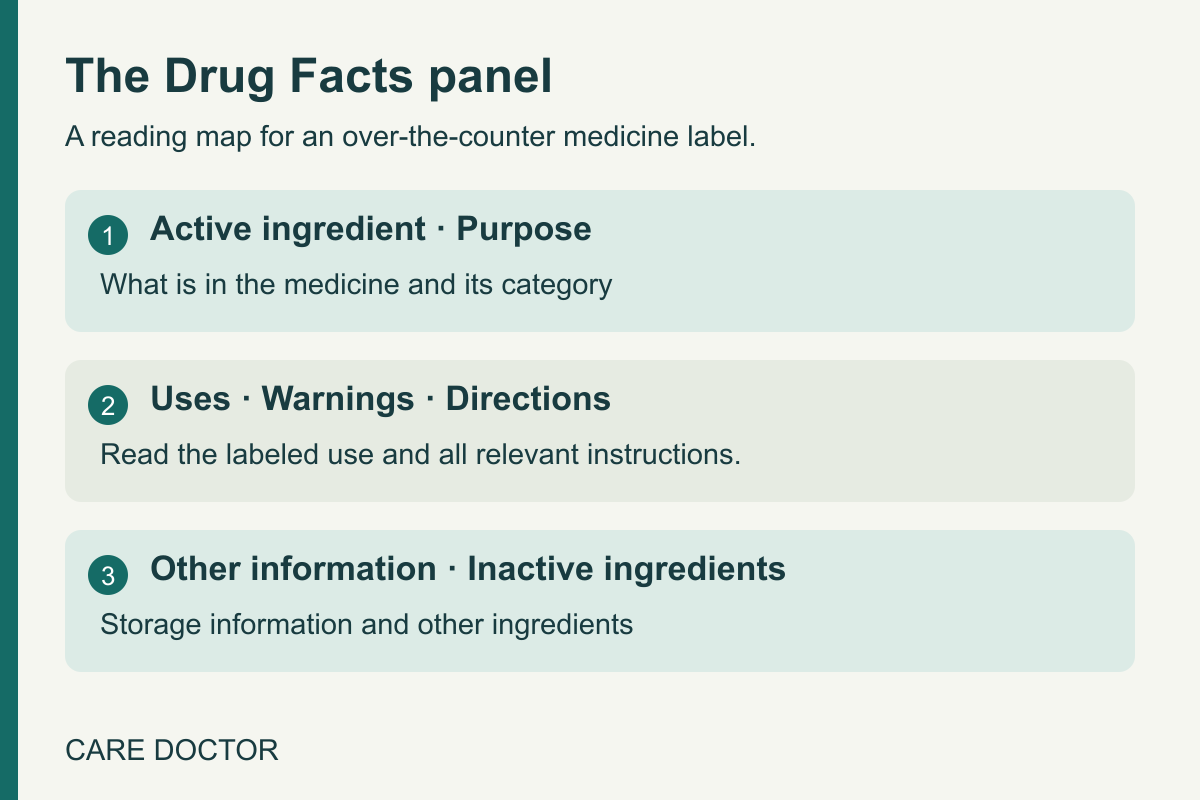
You are standing in a pharmacy aisle with a box in your hand and a few minutes to spare. The front has large words on it. The back has a block of small print headed Drug Facts. For nonprescription medicines in the United States, that block is where the standardized information lives, and it appears in the same order on every product. Once you know what each part says, you can tell which questions the label answers and which ones belong with a pharmacist or clinician.
Why read the label every time?
The FDA calls reading the label the most important part of taking care of yourself or your family when using nonprescription medicines, and it points out that these products can be taken without seeing a doctor. Its Drug Facts label page says FDA regulation makes the labels on all OTC medicines list information in the same order, in a consistent style, with easier-to-understand words. The same page warns that many OTC medicines have similar brand names with different active ingredients, and that manufacturers sometimes change ingredients, dosages or warnings. That is the reason to read the label each time you use a product, even one you have used before.
What do the seven Drug Facts headings mean?
The panel has seven headings, always in the same order, and each answers a different question.
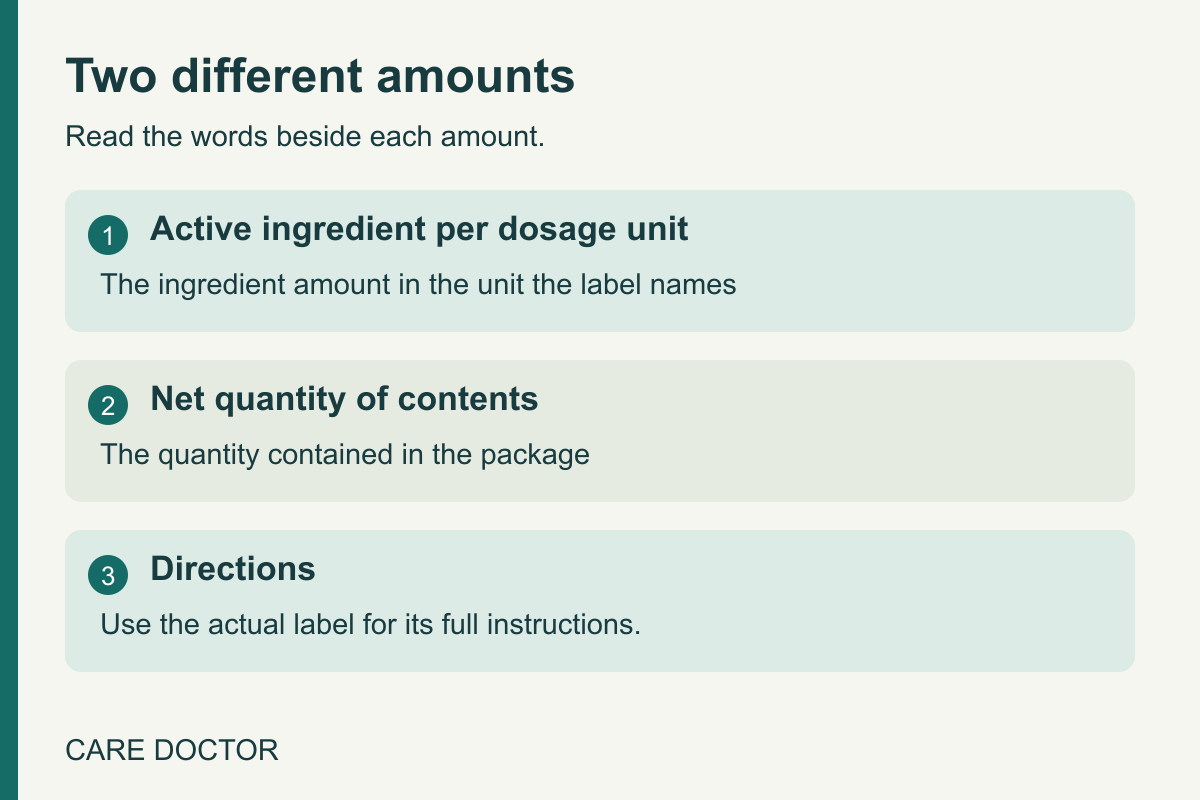
Active ingredient comes first. It names the substance in the product that causes the intended therapeutic effect and states the amount of that substance for each dosage unit. That amount is per unit, meaning the single portion the label counts, so it is not a total for the whole package. When two products have similar names, this line is where you check whether they contain the same thing.
Purpose follows it and gives the product's action or pharmacologic category. A pharmacologic category is a group of medicines that act in a similar way. Reading the two lines together tells you what is inside and what kind of medicine it is.
Uses lists the symptoms or diseases the product will treat or prevent. The FDA's interactions guidance says this section tells you what the drug is used for and helps you find the best drug for your specific symptoms.
Warnings is the field to slow down for. According to the FDA, it covers when not to use the product, conditions that may require advice from a doctor before taking it, possible interactions or side effects, when to stop taking the product and when to contact a doctor, pregnancy or breastfeeding warnings, when it is appropriate to talk to a doctor or pharmacist, and keeping the product out of children's reach. The field covers many situations, so read all of it, not only the first line.
Directions covers how much to take, how to take it, how often and for how long. Amounts vary by product, so the instruction to follow is the one printed on the box in your hand. The FDA's interactions guidance describes this field as the length of time and the amount of the product that you may safely use, along with any special instructions on how to use it. MedlinePlus adds that you should not take an OTC medicine longer or in higher doses than the label recommends, and that if you have been taking one and your symptoms do not go away, you should contact your health care provider.
Other information explains how to store the product properly and gives information about certain ingredients, such as the amount of calcium, potassium or sodium it contains. The FDA's interactions guidance says Other information carries required ingredient details, such as sodium content, for people with dietary restrictions or allergies.
Inactive ingredients lists substances such as binders, colors or flavorings.
What else is printed on the package?
Outside the Drug Facts panel, the FDA says the label also gives a statement of identity covering the name, purpose and strength of the active ingredient, the net quantity of contents, and the name and address of the manufacturer, packer or distributor. It also carries a lot or batch code, which the FDA describes as manufacturer information to help identify the product. The net quantity tells you how much of the product is in each package, which is separate from the amount per dosage unit in the Active ingredient field.
On dates, the FDA lists the expiration date, when applicable, as the date after which you should not use the product. It adds that if there is no expiration date on the label, the drug should be considered expired three years after purchase. For storage, go back to the Other information field, where the label says how to store the product properly.
Drug Facts or Supplement Facts?
Drug Facts and Supplement Facts are different, and the difference changes what you can expect to find. The FDA says Drug Facts labeling requirements do not apply to dietary supplements, which are regulated as food products and labeled with a Supplement Facts panel. If you cannot tell which kind of product you have, check the title printed on the panel, and ask a pharmacist if you are still unsure.
What can the label not tell you?
A label cannot know your other medicines. The FDA's drug interactions page describes three broad kinds: drug-drug, drug-food or beverage, and drug-condition. It says interactions can make a drug less effective, cause unexpected side effects or increase the action of a drug, and that some can be harmful. When a doctor prescribes a new drug, the page says to discuss every OTC and prescription drug, supplement, vitamin, botanical, mineral and herbal you take, as well as the foods you eat.
If you still have questions after reading the label, the FDA's drug interactions page says to ask your doctor or pharmacist. The same page suggests asking whether you can take the drug with other drugs, whether you should avoid certain foods, beverages or other products, what interaction signs to know about, how the drug will work in your body, and where to find more information about the drug or your condition.
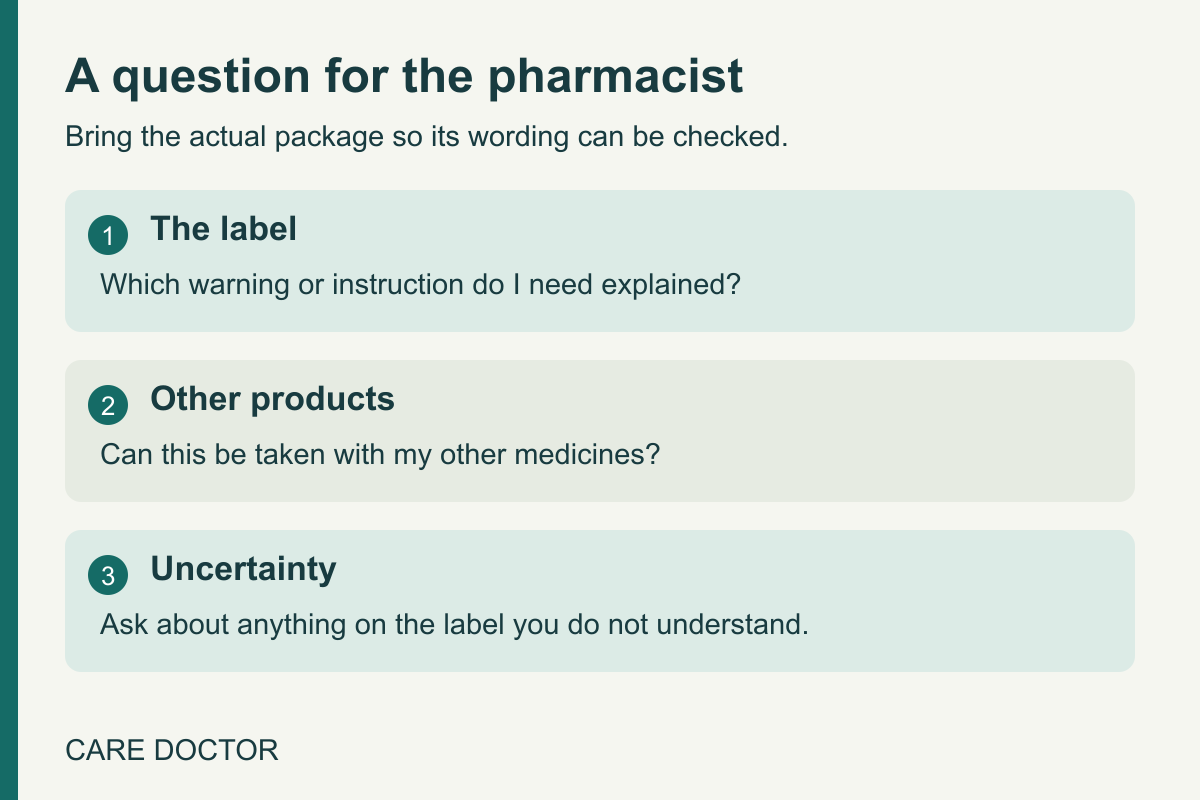
Reading every field takes time you may not have in an aisle. The fixed order helps, since your eye learns where each field sits, but the FDA still advises reading the label each time you use a product. If time is short, a pharmacist can go through the label with you.
Take one idea with you. The label tells you what the product says it contains, how it asks to be used, and which warnings it carries about interactions and conditions. It does not know your particular medicines or conditions, so any questions left after reading it are worth taking to a pharmacist or clinician.