Care Doctor
What to Bring to a Blood Pressure Appointment if You Measure at Home
Why a log needs context
Weeks of home readings can leave a person with a stack of numbers and a short appointment. A log helps when the clinician can see at a glance what was measured, how it was measured and when. A smaller set of clearly recorded readings is easier to use than a long page with no context. The National Heart, Lung, and Blood Institute (NHLBI) and the American Heart Association (AHA) both describe how blood pressure readings should be collected, and their guidance works as a practical checklist for anyone who plans to bring a monitor and a record to a visit.
Interpretation stays with the clinician. NHLBI explains that a clinician determines what readings mean, so a log is material for that conversation and not a verdict on its own. A good log lets the clinician judge whether the numbers were gathered in a way they can rely on, and it gives the reader something concrete to ask about.
The two numbers and where they are taken
A blood pressure reading has two numbers. NHLBI's diagnosis page distinguishes them: the upper number is systolic pressure, the force in the arteries when the heart beats, and the lower number is diastolic pressure, the force between beats. Writing them in the same order every time, upper then lower, prevents confusion when a clinician scans a column of entries.
NHLBI also explains that readings can be taken in a clinic or at home. That matters at an appointment, because a clinician may be comparing two settings and wondering whether they agree. Bringing the home monitor lets the clinician see the actual device, which comes up again with cuff fit and validation. For each entry, a useful log shows the date, the time, the arm used, both numbers and a brief note when something about the sitting was unusual. That list is a practical suggestion for organizing the page, not a requirement set by either organization.
Cuff fit and the upper arm
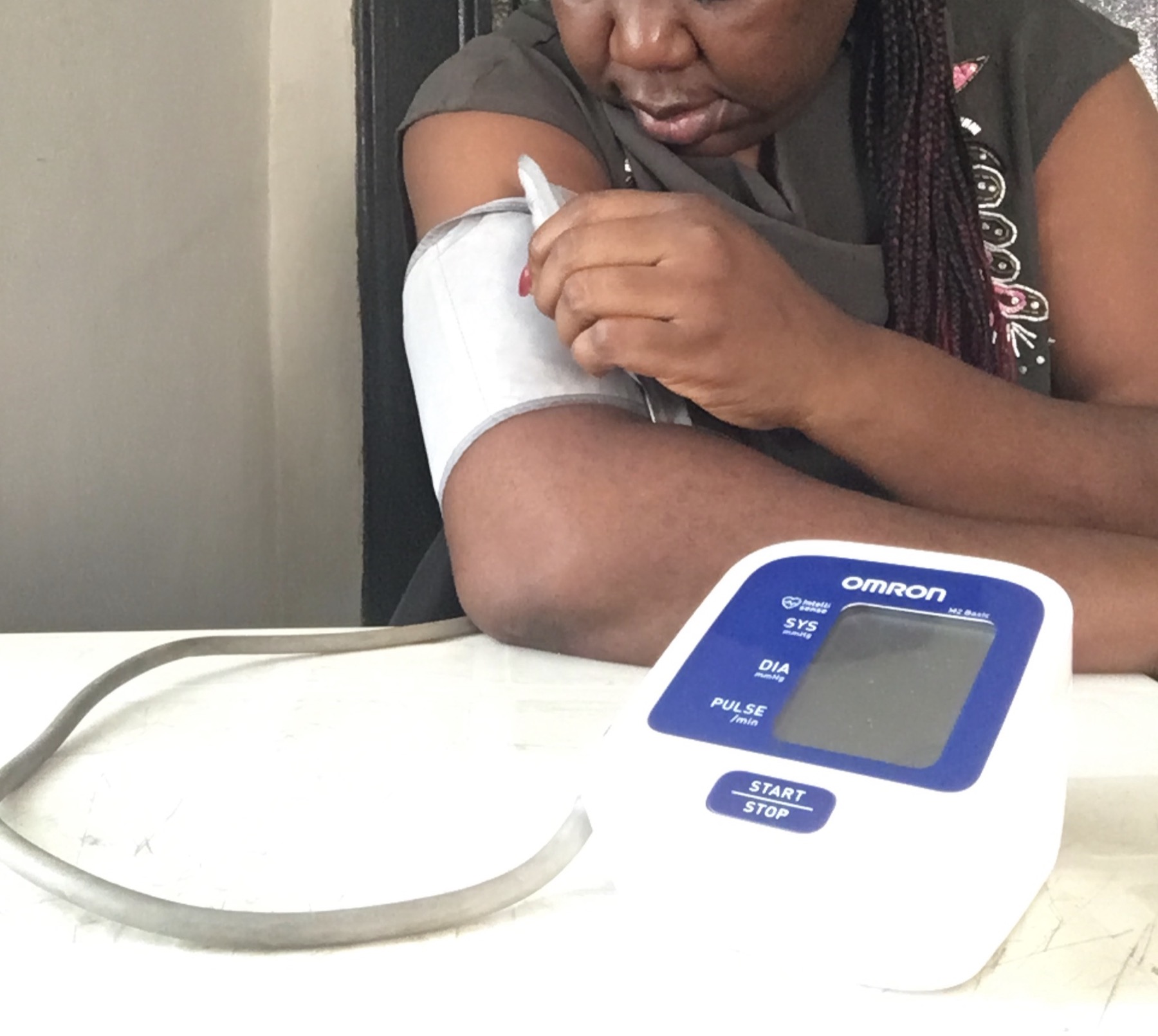
For a monitor with an upper-arm cuff, the AHA scientific statement explains that cuff fit shapes the reading. It names device validation, cuff fit, posture and the way readings are collected as factors that affect measurement. Validation means a monitor has been tested for accuracy against a reference method. A monitor that has not been validated, or a cuff that does not fit the arm, is a reason to ask how far the numbers can be relied on.
NHLBI's fact sheet adds a simple physical step: the cuff goes on a bare upper arm. Cuff fit can be hard to judge alone, so one good use of appointment time is asking a clinician or nurse to look at the cuff on the arm and say whether the size suits it. Bring the monitor with its cuff, so the check is of the equipment actually in use.

This is where careful logging can fail. A neat, complete log made with a poorly fitting cuff or an unvalidated monitor is still a record of numbers that may not be reliable. Tidiness cannot repair a measurement problem. If fit or the device is in doubt, raising that first is more useful than presenting more entries.
Posture and preparation
NHLBI's fact sheet describes preparing before a reading, supporting the arm and sitting in a set posture. The AHA statement also lists posture among the factors that affect measurement. Together, those points mean that how a person sat, and whether the arm was supported, belongs with a number as part of its record. A reading taken in a hurry with the arm unsupported and a reading taken after preparing, seated with the arm supported, are not the same kind of data.
The specific steps are in NHLBI's self-measured blood pressure fact sheet. A practical way to use the visit is to take a reading in front of the clinician or nurse, with the home monitor and the usual routine, and ask them to point out anything that differs from what they would want. Ask ahead whether the appointment allows time for this.
Recording repeated readings
NHLBI's fact sheet describes taking more than one reading, and the AHA statement notes that how readings are collected affects what they show. For a log, that means each sitting is better recorded as a group than as a single figure. Give each reading in the group its own line, with the date and time shown once for the sitting. Write down every reading taken, including the ones that seem unexpectedly high or low. Choosing only the best-looking number, or averaging mentally, removes information the clinician needs to judge how much the readings varied.
Two details are worth settling with the clinician instead of guessing. One is how many readings to take at each sitting and over how many days. The right schedule is the clinician's to set. The other is which arm to use and whether to keep using the same one. If the clinician wants an average, they can say how to work it out, and the raw entries make that possible.
A log with gaps is still usable if the gaps are honest. Leaving a day blank is better than filling it in from memory. A short note such as unwell, new monitor or different arm gives the clinician context without a long explanation in a short visit.

Questions worth asking, and when a log is the wrong tool
A log can generate too many questions, and a short visit rarely has room for ten. Two or three that come from the measurement itself serve better. Choose from these: Has my monitor been validated? Does this cuff size suit my arm? Could you watch me take a reading and tell me if my posture or arm support should change? How many readings should I record at each sitting, on which arm and over how many days? What should I do with a reading that looks very different from the others?
The practical objection is time and money. A validated monitor and a correctly sized cuff may cost something, and a log takes a few minutes at each sitting. A paper notebook or a phone note is enough for the log. If a new cuff is the question, ask the clinician about fit before buying anything. Whether home monitoring suits a particular person is also a question for the clinician. And a log is no substitute for care when someone feels unwell. Symptoms are a reason to contact a clinician or emergency services, not to wait for the next entry.
Before the appointment, the main thing to understand is that a blood pressure number carries the conditions of its measurement with it. Bring the monitor, bring a log with every reading from each sitting, and bring one or two questions about cuff size, posture and how many readings to record. The clinician decides what the numbers mean, and a clear record of how they were taken gives that decision firmer ground.