Care Doctor
What to Keep in a Baking Pantry, and What Belongs in the Fridge
Start your baking cupboard with the ingredients in a few recipes you actually want to make. Flour, sugar and a raising agent cover plenty of ground; a collection of specialty ingredients can wait until you have a use for them.
Buying a large bag isn't automatically useful if you rarely bake. Dry ingredients have different storage needs and useful lives, and some baking supplies belong in the refrigerator. Here's how to sort the basics.
Flour: check the recipe first
All-purpose flour works in many cakes, cookies and quick breads. Bread flour, cake flour, rye and gluten-free blends behave differently, so use the type the recipe specifies rather than assuming they're interchangeable. There's no need to buy each one for a starter cupboard. Flour is usually a raw food, even though it looks ready to use. The FDA's flour-safety guidance says to avoid tasting raw dough or batter, bake as directed, keep flour away from ready-to-eat foods and wash hands, utensils and work surfaces after handling it.
Choose sugar for the job
Granulated sugar is a common baking ingredient. Powdered sugar is useful for recipes such as icings, while brown sugar supplies a different flavor. Buy the kinds your recipes call for. Light and dark brown sugar aren't identical, and changing the type or amount of sugar can affect the result. Follow the recipe before experimenting with swaps.
Baking powder and baking soda are different
Baking powder contains both a base and an acid. Double-acting powder reacts when moistened and again during baking. Baking soda needs an acidic ingredient in the recipe, such as buttermilk or lemon juice. King Arthur Baking explains why some recipes use both. Don't substitute equal quantities of one for the other, and check the container's date before relying on an old supply.
Match the cocoa to the recipe
Unsweetened cocoa powder is useful for chocolate baking. Natural and Dutch-process cocoa differ in acidity, which can matter when a recipe uses chemical leaveners. Choose the specified type rather than treating every cocoa powder as equivalent.
Add dried fruit and nuts when needed
Raisins, dates, walnuts or almonds can go on the shopping list when a recipe needs them. You don't need every variety waiting in the cupboard. Follow the package's storage directions, and ask about allergies if you're baking for someone else.
Gelatin is recipe-specific
Unflavored gelatin is worth buying if you're planning a dessert that calls for it. It isn't required for every pudding or custard. Follow that recipe's preparation instructions and the product label rather than adding it to a dessert simply because it's in the cabinet.
Keep flavorings practical
Vanilla extract is a useful starting point if it appears in your recipes. Almond and other extracts can wait until needed. A more expensive bottle isn't a requirement for getting started; choose the product your recipe specifies and measure it as directed.
Use the fat the recipe specifies
Vegetable shortening and butter have different compositions and can produce different textures. Keep shortening if you have recipes that use it, rather than treating it as a necessary replacement for butter. Check the product's storage instructions, too.
Separate cupboard supplies from cold ingredients
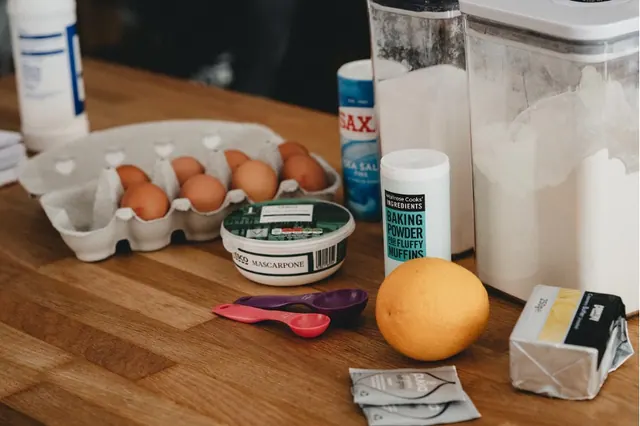
Keep dry foods covered in a dry storage area, separate from cleaning supplies, and rotate older stock forward. Nebraska Extension's storage chart distinguishes pantry foods from refrigerated ingredients. In a U.S. kitchen, store eggs promptly in the refrigerator at 40°F or below. Refrigerate perishable dairy, including the mascarpone shown in the photograph, according to its label. A counter arrangement for baking is temporary preparation, not a guide to long-term storage.