Dosing
How much of each nutrient a daily multivitamin provides
A plain-language look at what standard multivitamins actually contain, how those amounts compare to recommended intakes, and what the evidence says about their usefulness.
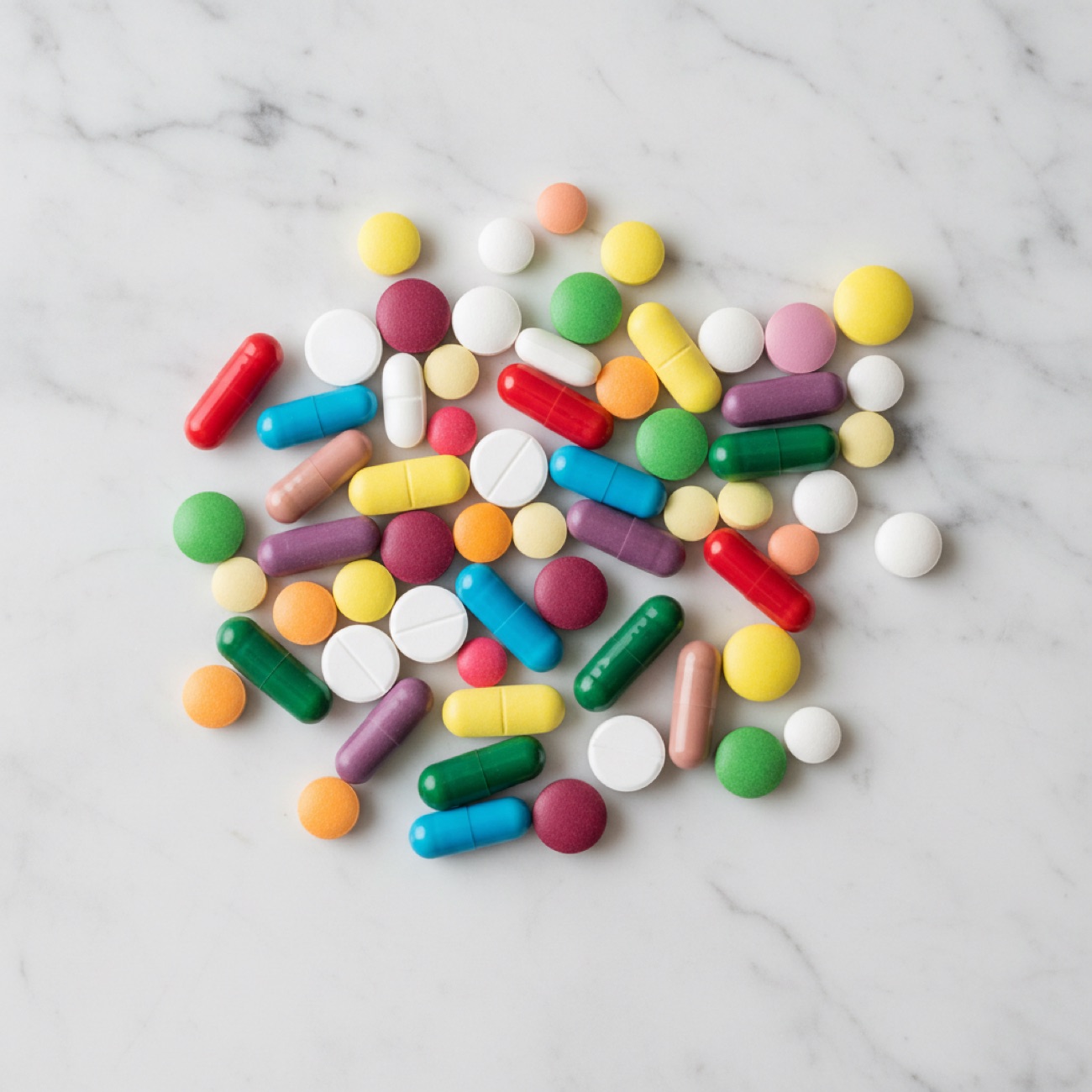
A standard daily multivitamin is formulated to supply a broad range of vitamins and minerals, usually at amounts close to the Recommended Dietary Allowance (RDA) or Adequate Intake (AI) for each nutrient. Whether that is enough, too little, or more than you need depends on your age, sex, diet, and health status, so always talk with a clinician or pharmacist before choosing a specific product.
What "recommended amount" actually means
The National Academies of Sciences, Engineering, and Medicine publish Dietary Reference Intakes (DRIs) for each nutrient. The two values most relevant to multivitamin labels are:
- RDA (Recommended Dietary Allowance): the average daily intake sufficient to meet the needs of nearly all healthy people in a given age and sex group, according to the NIH Office of Dietary Supplements (ODS).
- Tolerable Upper Intake Level (UL): the highest daily intake unlikely to cause harm. Regularly exceeding the UL raises the risk of adverse effects.
A third value, the Adequate Intake (AI), is used when evidence is not strong enough to set a full RDA. Multivitamin labels express amounts as a percentage of the Daily Value (DV), which is a single reference figure used for food labeling and is based on a 2,000-calorie diet for adults.
How multivitamin amounts compare to RDAs
According to the NIH ODS, a basic multivitamin and multimineral supplement (MVM) is generally designed to provide nutrients at roughly recommended amounts. The table below summarizes common nutrient categories found on multivitamin labels and how they relate to DRI benchmarks. Exact amounts vary by brand and product type, so always read the Supplement Facts panel on your specific product.
Fat-soluble vitamins
- Vitamin A: RDAs range from 700 mcg RAE for adult women to 900 mcg RAE for adult men. Many standard MVMs provide 100 percent of the DV. The UL for preformed vitamin A (retinol) is 3,000 mcg RAE per day for adults; beta-carotene in supplements is not assigned a UL but high doses are not recommended for smokers.
- Vitamin D: The RDA is 600 IU (15 mcg) for adults aged 19 to 70 and 800 IU (20 mcg) for adults over 70. The UL is 4,000 IU (100 mcg) per day for adults. Many MVMs provide 400 to 1,000 IU, though amounts vary widely by product.
- Vitamin E: The RDA is 15 mg (22.4 IU natural form) for adults. The UL is 1,000 mg per day. Most standard MVMs stay well below the UL.
- Vitamin K: The AI is 90 mcg per day for adult women and 120 mcg per day for adult men. No UL has been established. See the drug interaction section below for an important note about vitamin K and blood thinners.
Water-soluble vitamins
- Vitamin C: The RDA is 75 mg for adult women and 90 mg for adult men, with an additional 35 mg recommended for smokers. The UL is 2,000 mg per day.
- B vitamins (thiamin, riboflavin, niacin, B6, B12, folate, biotin, pantothenic acid): RDAs and AIs differ by specific B vitamin and life stage. Folate is especially important: the RDA is 400 mcg DFE for most adults and 600 mcg DFE during pregnancy. Most standard MVMs supply B vitamins at or near 100 percent of the DV. The UL for folate from supplements and fortified foods is 1,000 mcg DFE per day for adults. No UL has been set for B12, thiamin, riboflavin, biotin, or pantothenic acid.
Minerals
- Calcium: The RDA is 1,000 mg per day for adults aged 19 to 50 and 1,200 mg for women over 50 and all adults over 70. Most standard MVMs provide only 100 to 200 mg because calcium is bulky; dietary sources are expected to supply the rest.
- Iron: The RDA is 8 mg for adult men and postmenopausal women, and 18 mg for premenopausal women. The UL is 45 mg per day. Some MVMs are iron-free; others provide close to the full RDA. Excess iron can cause gastrointestinal discomfort and, at very high doses, serious harm.
- Iodine: The RDA is 150 mcg for adults and 220 mcg during pregnancy. The UL is 1,100 mcg per day. Iodine is highlighted by the Dietary Guidelines for Americans as a key nutrient during pregnancy.
- Zinc, selenium, copper, manganese, chromium, molybdenum: These trace minerals are present in many MVMs at amounts near their RDAs or AIs. Each has its own UL, so cumulative intake from multiple supplements and fortified foods should be monitored.
Safety: the cumulative excess concern
The NIH ODS states that taking a basic MVM providing nutrients at about recommended amounts is considered safe for healthy people. Studies of MVM users have found no adverse effects beyond minor gastrointestinal complaints, and those complaints occurred at similar rates in placebo groups. The main safety concern is cumulative excess: using an MVM together with other individual supplements and heavily fortified foods, or choosing a high-potency MVM, can push total intake of certain nutrients above the UL. This is particularly relevant for vitamin A, iron, zinc, and vitamin D. Please note that these statements have not been evaluated by the FDA, and supplements are not intended to diagnose, treat, cure, or prevent any disease.
Drug interactions to know
According to the NIH ODS, MVMs providing nutrients at recommended amounts do not ordinarily interact with medications, with one important exception. Vitamin K in an MVM can reduce the effectiveness of warfarin (Coumadin, Jantoven) and similar anticoagulants. Anyone taking a blood thinner should talk with their doctor or pharmacist before using any MVM or supplement containing vitamin K. Separately, proton pump inhibitors and other acid-reducing medications can decrease absorption of food-bound vitamin B12, which is worth discussing with a clinician if you rely on an MVM for B12 intake.
What the research says
The NIH ODS grades the evidence for MVM use as follows:
- Strong evidence: Taking an MVM increases total intake of vitamins and minerals and helps people reach recommended amounts when diet alone falls short.
- Strong evidence: Periconceptional folic acid, commonly obtained through a prenatal MVM, is associated with a reduced risk of neural tube defects.
- Moderate evidence: Prenatal MVMs are associated with improved birth outcomes such as reduced rates of low birth weight and preterm birth compared with iron and folic acid alone.
- Moderate evidence: A specific high-dose antioxidant plus zinc formula (the AREDS formula) is associated with slowed progression from intermediate to advanced age-related macular degeneration.
- Limited evidence: MVMs may reduce overall cancer risk; evidence is not conclusive.
- Limited evidence: MVMs may help maintain cognition in older adults; more research is needed.
- Insufficient evidence: MVMs have not been shown to prevent cardiovascular disease, reduce CVD mortality, or reduce all-cause mortality.
The bottom line
A standard daily multivitamin is designed to deliver a broad range of vitamins and minerals at amounts close to population-level recommendations established by the National Academies and described by the NIH ODS. It can help fill dietary gaps, and it plays a well-supported role during pregnancy for nutrients such as folic acid, iron, iodine, and vitamin D. It is not a substitute for a balanced diet, and it does not carry strong evidence for preventing chronic disease. Because nutrient needs vary by age, sex, and health status, consult a clinician or pharmacist to decide whether an MVM is appropriate for you and which formulation best matches your needs.
Sources
- S1.gov verifiedNIH Office of Dietary SupplementsMultivitamin/mineral Supplements - Health Professional Fact Sheetods.od.nih.gov/factsheets/MVMS-HealthProfessional/
- S2.gov verifiedNIH Office of Dietary SupplementsMultivitamin/mineral Supplements - Consumer Fact Sheetods.od.nih.gov/factsheets/MVMS-Consumer/
- S3.gov verifiedNational Academies of Sciences, Engineering, and Medicine (Food and Nutrition Board)Dietary Reference Intakes: The Essential Guide to Nutrient Requirementsnap.nationalacademies.org/catalog/11537/dietary-refe
- S4.gov verifiedU.S. Preventive Services Task ForceVitamin, Mineral, and Multivitamin Supplementation to Prevent Cardiovascular Disease and Cancer: Preventive Medicationwww.uspreventiveservicestaskforce.org/uspstf/recomme