Sleep
Sleep Supplements Ranked by Evidence: Melatonin, Valerian, and Magnesium
A plain-language look at what the NIH Office of Dietary Supplements actually says about three popular sleep supplements and how strong the evidence behind each one really is.
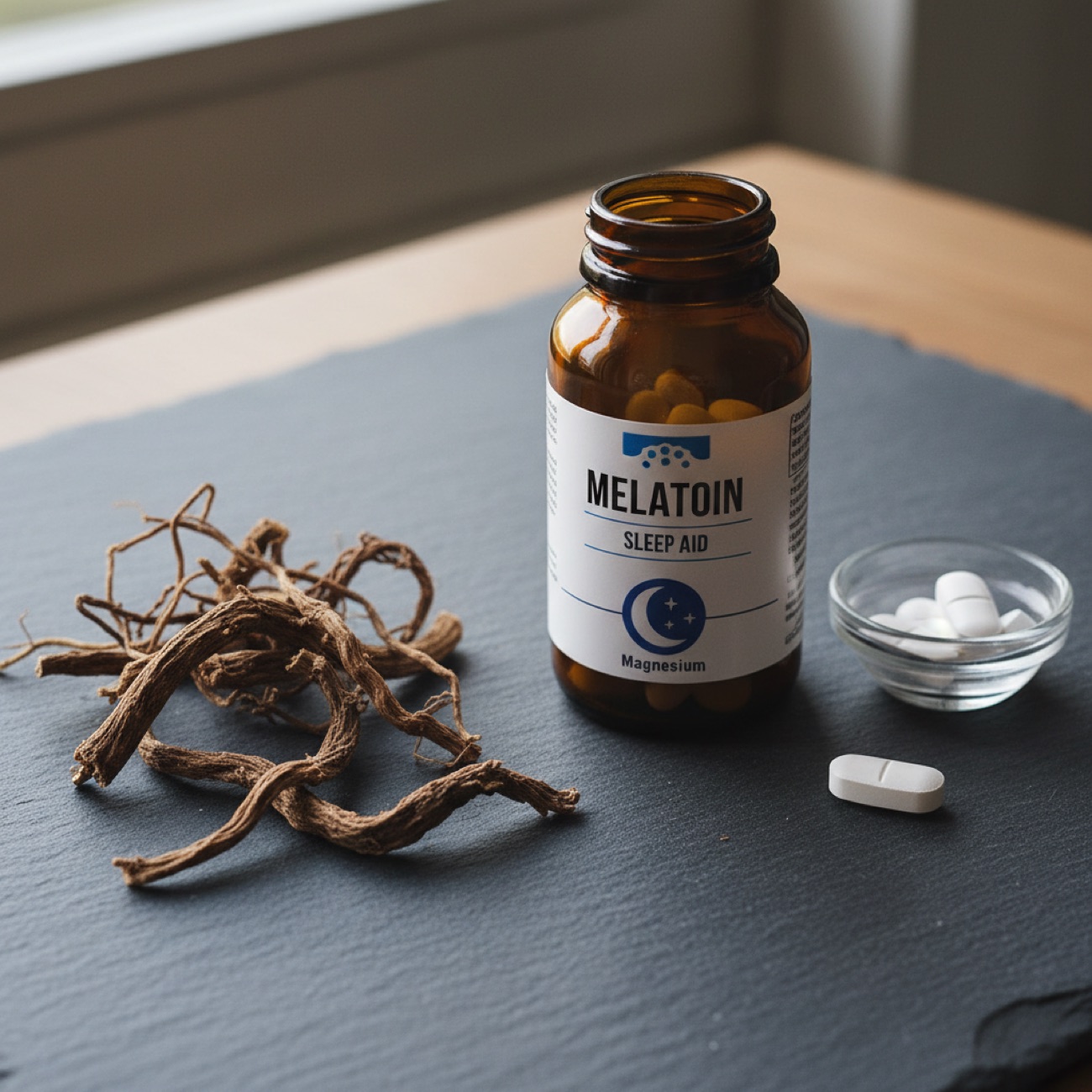
If you have ever stood in a pharmacy aisle wondering which sleep supplement is worth trying, you are not alone. This guide ranks melatonin, valerian, and magnesium by the strength of the evidence behind them, drawing entirely from data published by the NIH Office of Dietary Supplements and related NIH sources.
Please note that dietary supplements are not intended to diagnose, treat, cure, or prevent any disease, and these statements have not been evaluated by the FDA. Always talk to a clinician or pharmacist before adding a supplement to your routine, especially if you take any medications.
How We Grade the Evidence
Each claim below carries one of four ratings that mirror the language used by the NIH: Strong, Moderate, Limited, or Insufficient. Strong means consistent, high-quality evidence supports the finding. Insufficient means the research is too sparse or inconsistent to draw a conclusion.
1. Melatonin
What it does in the body
Melatonin is a hormone produced by the pineal gland in response to darkness. According to the NIH, it helps time the body's circadian rhythms, the roughly 24-hour internal clock, and signals the body that it is time to sleep. Light exposure at night can suppress its production. No adult daily target or upper intake level has been established by the NIH for supplemental melatonin.
Evidence for sleep
- Melatonin regulates circadian rhythm and sleep timing: Strong
- May help reduce symptoms of jet lag: Limited
- May help people with delayed sleep-wake phase disorder fall asleep sooner: Limited
- May improve time to fall asleep and total sleep in some children with sleep problems: Limited
- Effective treatment for chronic insomnia: Insufficient
- Helps shift workers sleep: Insufficient
Safety notes
Short-term use appears to be safe for most people, but long-term safety data are limited. At doses higher than the body normally produces, the overall safety picture is unclear. Reported side effects are generally mild and include headache, dizziness, nausea, and daytime sleepiness. Because melatonin can cause drowsiness, avoid driving or operating machinery after taking it.
Key drug interactions
- Blood-thinning medicines such as warfarin: possible increased bleeding risk; use only under medical supervision
- Anticonvulsant medicines: melatonin may affect seizure control; medical supervision is advised
- Sedatives, hypnotics such as benzodiazepines or zolpidem, and alcohol: combining with melatonin may cause excessive sedation
- CYP1A2 inhibitors such as fluvoxamine: can raise melatonin blood levels; estrogens and quinolone antibiotics may also increase melatonin levels
2. Magnesium
What it does in the body
Magnesium is an essential mineral that acts as a cofactor in more than 300 enzyme systems. The NIH Office of Dietary Supplements notes it supports normal muscle and nerve function, contributes to blood glucose control, and plays a role in blood pressure regulation. The adult recommended intake is 400 to 420 mg per day for men and 310 to 320 mg per day for women aged 19 to 50, according to NIH Dietary Reference Intake data.
Evidence related to sleep and health
- Required for normal muscle and nerve function, energy production, and bone structure: Strong
- May help prevent migraine headaches: Moderate
- Higher intake associated with lower risk of high blood pressure: Limited
- Higher intake associated with lower risk of type 2 diabetes: Limited
- Supports bone mineral density: Limited
It is worth noting that the NIH has not assigned a specific evidence rating for magnesium as a direct sleep aid. Its connection to sleep is indirect, through its role in nerve function and muscle relaxation.
Safety notes
Magnesium from food is safe for healthy people because the kidneys excrete excess amounts. The NIH sets the Tolerable Upper Intake Level for supplemental magnesium at 350 mg per day for anyone aged 9 and older. This limit applies only to magnesium from supplements and medications, not from food. Exceeding it can cause diarrhea and other gastrointestinal effects. Higher doses used in some research, for example for migraine prevention, exceed this limit and should only be taken under a clinician's direction.
Key drug interactions
- Bisphosphonates such as alendronate: magnesium can reduce absorption; separate doses by at least 2 hours
- Tetracycline and quinolone antibiotics: magnesium can form insoluble complexes; take antibiotics at least 2 hours before or 4 to 6 hours after a magnesium supplement
- Loop and thiazide diuretics such as furosemide: chronic use can increase urinary magnesium loss and lead to depletion
- Potassium-sparing diuretics such as amiloride: reduce magnesium excretion
3. Valerian
What it does in the body
Valerian is an herbal supplement marketed as a mild sedative and sleep aid for nervous tension and insomnia. The NIH Office of Dietary Supplements states that clinical evidence of efficacy for sleep disorders is inconclusive. One proposed mechanism is that valerian constituents may increase the amount of the inhibitory neurotransmitter GABA available in the synaptic cleft, though whether this contributes to sedation in humans is not known. No adult daily target or upper intake level has been established.
Evidence for sleep
- Valerian constituents have sedative effects in animal and laboratory studies: Limited
- Valerian improves insomnia or sleep disorders in humans: Insufficient
- Valerian increases GABA availability in the human synapse: Insufficient
Safety notes
Few adverse events have been reported in clinical trials, but long-term safety data are not available. Women who are pregnant or nursing should not take valerian without medical advice because possible risks to the fetus or infant have not been evaluated. Children younger than 3 years old should not take valerian for the same reason.
Key drug interactions
- Benzodiazepines such as alprazolam, diazepam, lorazepam, and triazolam: possible additive sedative effects
- Barbiturates and CNS depressants such as phenobarbital, morphine, and propofol: possible additive sedative effects
- Alcohol and other sedative drugs: theoretical possibility of additive sedation
- Other supplements with sedative properties such as kava, St. John's wort, and melatonin: possible additive effects
Side-by-Side Summary
- Melatonin: best evidence for circadian timing and jet lag; insufficient evidence for chronic insomnia
- Magnesium: strong evidence for physiological roles in nerve and muscle function; indirect relevance to sleep; moderate evidence for migraine prevention
- Valerian: limited to insufficient evidence across all sleep-related claims
Bottom Line
Of the three supplements covered here, melatonin has the strongest and most direct evidence for sleep-related uses, particularly for jet lag and circadian rhythm disruption, though even those ratings are only Limited. Magnesium earns a Strong rating for its fundamental physiological roles, but its direct effect on sleep has not been established at that same level. Valerian has the weakest evidence of the three, with the NIH rating its effect on insomnia as Insufficient.
None of these supplements should replace good sleep hygiene or a conversation with your doctor about ongoing sleep problems. Talk to a clinician or pharmacist before choosing a dose or combining any supplement with prescription or over-the-counter medications. All figures in this guide come from the NIH Office of Dietary Supplements.
Sources
- S1.gov verifiedNIH National Center for Complementary and Integrative Health (NCCIH)Melatonin: What You Need To Knowwww.nccih.nih.gov/health/melatonin-what-you-need-to-
- S2.gov verifiedNIH National Center for Complementary and Integrative Health (NCCIH)Sleep Disorders and Complementary Health Approaches: Usefulness and Safetywww.nccih.nih.gov/health/sleep-disorders-what-you-ne
- S3.gov verifiedNIH Office of Dietary Supplements (ODS)Dietary Supplement Fact Sheets (Melatonin listing, source: NCCIH)ods.od.nih.gov/factsheets/list-all/
- S4.gov verifiedInstitute of Medicine (IOM/NASEM) and National Research CouncilDietary Supplements: A Framework for Evaluating Safety - Appendix F: Melatonin Prototype Monograph Summarywww.ncbi.nlm.nih.gov/books/NBK216058/
- S5.gov verifiedNIH Office of Dietary Supplements (ODS)Valerian - Fact Sheet for Health Professionalsods.od.nih.gov/factsheets/Valerian-HealthProfessiona