Dosing
How much vitamin K you need each day
A practical guide to daily vitamin K targets, food sources, safety considerations, and who should take extra care.
Short answer: According to the NIH Office of Dietary Supplements, most adult men need 120 micrograms (mcg) of vitamin K per day and most adult women need 90 mcg per day. These figures are set as an Adequate Intake (AI) rather than a Recommended Dietary Allowance, because the evidence was not sufficient to establish an RDA at the time the value was set.
What is an Adequate Intake, and why does it matter?
A Recommended Dietary Allowance (RDA) is calculated from enough data to estimate the average requirement for a healthy population. When that level of evidence is not available, the National Academies of Sciences, Engineering, and Medicine set an Adequate Intake instead. The AI for vitamin K is based on observed intakes in healthy people and is considered sufficient to maintain adequate status, but it carries more uncertainty than an RDA. In practical terms, aiming to meet the AI through food is a reasonable goal for most healthy adults.
Daily targets by life stage
The following values come from the NIH Office of Dietary Supplements and apply to people who are generally healthy and not taking medications that affect vitamin K metabolism.
- Adult men (19 and older): 120 mcg per day
- Adult women (19 and older): 90 mcg per day
- Pregnant and breastfeeding women: 90 mcg per day (same as the general adult women's AI)
No Tolerable Upper Intake Level (UL) has been established for vitamin K, because the nutrient has a low potential for toxicity. This does not mean unlimited intake is without risk for everyone. As explained below, people on certain medications face meaningful safety concerns regardless of the absence of a UL.
What vitamin K does in the body
Vitamin K has well-documented physiological roles supported by strong evidence.
Blood clotting
Vitamin K acts as a coenzyme for vitamin K-dependent carboxylase, the enzyme required to synthesize proteins involved in hemostasis, which is the process that stops bleeding. One of the most important of these proteins is prothrombin, also called clotting factor II. Without adequate vitamin K, the body cannot produce functional clotting factors, and normal wound healing is impaired. The evidence for this role is rated strong by the NIH Office of Dietary Supplements.
Bone metabolism
Vitamin K supports the carboxylation of osteocalcin, a vitamin K-dependent protein found in bone that may be involved in bone mineralization or turnover. The evidence that vitamin K plays a role in bone metabolism is also rated strong. Whether supplementing beyond the AI meaningfully reduces the risk of osteoporosis or fracture is a separate question, and the evidence for that specific outcome is currently rated limited, meaning more research is needed before firm conclusions can be drawn.
Cardiovascular research
Some observational studies suggest that higher intake of menaquinone, the form of vitamin K found in fermented foods and produced by gut bacteria, is associated with less vascular calcification and a lower risk of coronary heart disease. The NIH rates this evidence as limited. It is not possible to conclude from current data that taking a vitamin K supplement prevents heart disease.
Note: Supplements are not intended to diagnose, treat, cure or prevent any disease, and these statements have not been evaluated by the FDA.
Food sources
Most people in the United States meet the AI through diet alone. Vitamin K is found in two main forms in food.
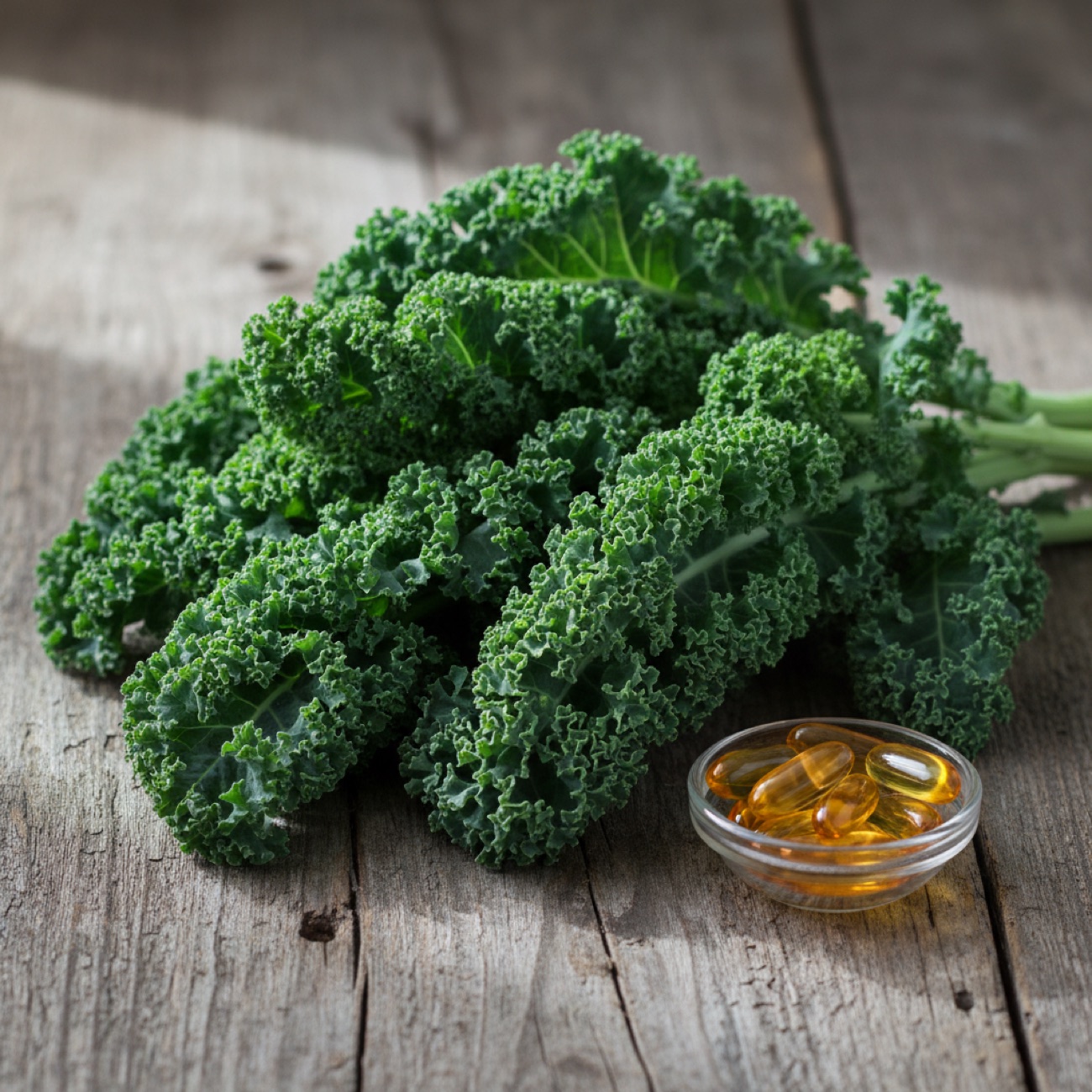
- Phylloquinone (K1): The primary dietary form, found in green leafy vegetables such as kale, spinach, collard greens, broccoli, and Brussels sprouts. Vegetable oils and some fruits also contribute.
- Menaquinones (K2): Found in fermented foods such as natto (a Japanese fermented soybean product), some cheeses, and meat. Gut bacteria also produce menaquinones, and research rated at a moderate evidence level suggests these contribute meaningfully to the body's overall vitamin K supply.
Because vitamin K is fat-soluble, consuming it alongside a small amount of dietary fat improves absorption.
Who may have lower vitamin K status
Deficiency is uncommon in healthy adults who eat a varied diet, but certain situations can reduce vitamin K status.
- People with conditions that impair fat absorption, such as Crohn's disease, celiac disease, or short bowel syndrome
- People who have taken antibiotics for several weeks or longer, particularly if their diet is also low in vitamin K, since antibiotics can reduce the gut bacteria that produce menaquinones
- Newborns, who are routinely given a vitamin K injection at birth to prevent a rare but serious bleeding condition
If you think you may be at risk for deficiency, speak with a clinician before starting a supplement. A healthcare provider can assess your individual needs and recommend an appropriate amount.
Drug interactions: the most important safety consideration
Although vitamin K itself has low toxicity, it has serious interactions with several medications. Always talk to a doctor or pharmacist before combining vitamin K supplements with any prescription or over-the-counter drug.
- Warfarin (Coumadin) and similar anticoagulants: Warfarin and related drugs such as phenprocoumon and acenocoumarol work by antagonizing vitamin K activity and depleting vitamin K-dependent clotting factors. Sudden changes in vitamin K intake, whether up or down, can increase or decrease the anticoagulant effect and create a potentially dangerous situation. People taking these drugs must keep their vitamin K intake from both food and supplements consistent day to day. This is one of the most clinically significant nutrient-drug interactions known.
- Antibiotics: Prolonged antibiotic use can reduce vitamin K-producing gut bacteria and lower vitamin K status. Certain cephalosporins such as cefoperazone may also directly inhibit vitamin K action.
- Bile acid sequestrants (cholestyramine, colestipol): These cholesterol-lowering drugs can reduce the absorption of vitamin K and other fat-soluble vitamins. Vitamin K status should be monitored with long-term use.
- Orlistat (Alli, Xenical): This weight-loss drug reduces dietary fat absorption, which can lower absorption of fat-soluble vitamins including vitamin K. When combined with warfarin, orlistat may significantly increase prothrombin time, raising bleeding risk.
Do you need a supplement?
For most healthy adults who eat green vegetables regularly, a supplement is unlikely to be necessary to meet the AI. Supplements may be considered in cases of documented deficiency or malabsorption, but the decision should be made with a clinician who can weigh your full medical picture, including any medications you take.
If you do use a vitamin K supplement, look for a product that clearly states the amount per serving in micrograms so you can track your total daily intake from all sources.
The bottom line
The NIH Office of Dietary Supplements sets the daily Adequate Intake for vitamin K at 120 mcg for adult men and 90 mcg for adult women. Vitamin K plays essential, well-evidenced roles in blood clotting and bone metabolism. Most people can meet these targets through a diet that includes green leafy vegetables. The primary safety concern is not toxicity but interaction with anticoagulant medications, which requires consistent intake and medical supervision. Consult a clinician or pharmacist for guidance specific to your health situation before changing your vitamin K intake through supplements.
Sources: NIH Office of Dietary Supplements Vitamin K Fact Sheet for Health Professionals (ods.od.nih.gov); NIH Office of Dietary Supplements Vitamin K Fact Sheet for Consumers (ods.od.nih.gov); Dietary Reference Intakes for Vitamin A, Vitamin K, and other nutrients, National Academies of Sciences, Engineering, and Medicine (nap.nationalacademies.org).
Sources
- S1.gov verifiedNIH Office of Dietary SupplementsVitamin K - Health Professional Fact Sheetods.od.nih.gov/factsheets/VitaminK-HealthProfessiona
- S2.gov verifiedNIH Office of Dietary SupplementsVitamin K - Consumer Fact Sheetods.od.nih.gov/factsheets/VitaminK-Consumer/
- S3.gov verifiedInstitute of Medicine (now NASEM), Food and Nutrition BoardDietary Reference Intakes for Vitamin A, Vitamin K, Arsenic, Boron, Chromium, Copper, Iodine, Iron, Manganese, Molybdenum, Nickel, Silicon, Vanadium, and Zinc (2001)nap.nationalacademies.org/catalog/10026/dietary-refe